And we revisit the Palace Of The King! In the original article I
gave a potted history of Freddkie King's life and career, so we won't
belabour that here... suffice it to say that by the time he was my
age at the time of writing, Mr. King had 7 kids and been dead for a
year, and it's hard to think that the two things weren't
intertwined... and of course his habit of substituting Bloody Marys
in lieue of actual meals can't have helped... anyway, let's dive
straight into the style!
As a primarily pentatonic player, one of the key facets pf
Freddie's style was an ability to deftly switch between minor and
major pentatonic – I think one of the best examples of this comes
in his “pop” hit, “I Would Rather Be Blind”, where he moves
between G minor pentatonic for the fills in the verses and switches
to E minor- the relative minor of G major – fo rthe bridge section,
and he takes a lightly more elegant approach than simply shifting
everything three frets back:
As you can see, the minor pentatonic (R b3 4 5 b7) and major
pentatonic (R 2 3 5 6) do share some notes – the root and 5th.
Not just that, but the 2nd and 6th – the
“sweet” notes – are located just a semitone below the b3 and b7
in the minor pentatonic, and the major 3rd can be accessed by bending
the 2nd up a tone.
Another noticeable aspect of his style is the way he would “change
gear” by shifting to different pentatonic shapes – generally he
would use shape 1 to create fills around the vocal, before moving to
shape 2 to begin the solo. However, he doesn't always stay there –
there's a nice contrary motion effect he gets by moving from shape 2
to shape 1 when the chord sequence moves to the IV. Check out this
lick from “Me & My Guitar” to see this idea in action:
This lick works by targeting the 5th of each chord –
bending the A up to a B over the E chord, and then D up to E over the
A chord, finishing up with a quarter tone tweak in between minor and
major 3rd over the E chord.
There's some neat turnaround work in the same track, following the
chord pattern – B7, A7, E7, B7 – outlining the arpeggios and with
some chromatic passing notes thrown in and using the open E minor
pentatonic with a healthy dose of major 3rd added.
An often overlooked part of Freddie's technique was his use of
hybrid or fingerpicking to access wider interval jumps across
strings, and there's an interesting example of this in “Just A
Little Bit” - jumping from the D to the B strings and back again,
before faking you out a little bit... just when you think he's about
to resolve to the root (Bb) on the low E, he instead reaches out with
his pick hand middle finger to pick the high E instead. It's a
really interesting, quirky effect.
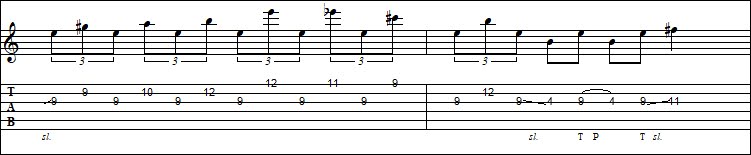
The same solo ends with a neat “tension and release” scale run
– a long, held bend from the b7 up to the root providing the
tension, and a flurry of pentatonic triplets providing the release –
think of pulling back an elastic band and then letting go! Also,
check out the way Freddie would weave pre-bends into the run, as well
as the bluesy aggression caused by resolving the lick to the b7
instead of the root:
So, plenty to take away and play with from this month – just
remember kids, a Bloody Mary is NOT A nutritional breakfast!
Next month, an internet legend and very possibly a serious coup..
let's keep those fingers crossed....
And with a bang, we jump right into the 21st century to
examine the playing style of YouTube sensation Sophie Lloyd! I first
became aware of her when Guitar World did a piece on her version of“Bohemian Rhapsody” during summer 2020, and I will hold my hands
up here- when I clicked on the video and was met with the image of
the glamorous blonde, perfect make up etc, my inner cynic's first
thought was “OK, I can see why she's popular..”
By about the fourth bar, however, my inner cynic had shut up
entirely, and I was busy picking my jaw up off the floor. Now, here's
the thing – when you're confronted by someone on YouTube who's a
better player than you, you can either think a) “Oh, this is
hopeless, I'll never be able to do that, might as well give up now”
or b) “Right, let's slow that down and figure out what he/she is
doing there then”. I chose “b”, and (as any of you who follow
my One Minute Lick posts on Instagram will be aware) have been
richly rewarded with an absolute plethora of licks and runs, which
we'll take a look at in this article.
First, a little potted history - Sophie began playing guitar at a
young age and reached grade 8 by age 16, drawing influence from
classic rock and metal bands like Iron Maiden, Pantera and Black
Label Society (a fellow Zakk Wylde fan!) and went on to complete a
music degree at the Brighton Institute of Modern Music (BIMM) London,
graduating with first class honours.. She released her first EP,
“Delusions” in 2018, but the real source of her fame is
undoubtedly her YouTube channel, where as well as gear demos and
original music she performs shred versions of classic rock tunes such
as “Bohemian Rhapsody” and “Highway To Hell”. Beyond that,
information is a little bit sketchy, but it's safe to say that unlike
most of the players we've checked out in the blog she's at the
beginning of her career, rather than being firmly established like
Neil Zaza or, well, dead. So one to to keep an eye on, especially as
she's building up to a big release.
So, onto the juicy stuff – the licks! I'll admit to being a bit
intimidated at first but when I started slowing things down and
drilling down into the detail I started to decode some of the
patterns she tends to favour, and like most of us, her playing is
based predominantly around the minor pentatonic and position 1 three
note per string major scale shapes.
She often favours simple repeating “stacked” patterns of 6 and
12 notes, played in a sextuplet (six note per beat) rhythm – count
“1 & a 1 & a, 2 & a 2 & a..” etc to get this
feel. Make sure to try these lines both picked and legato (hammer-ons
and pull-offs), and of course in every key.
A word on practicing these patterns – all too often students
practice these patterns in isolation and then find they struggle to
apply them. One trick to use to help here is to alternate rhythm and
lead – for example , in the examples tabbed, practice chugging on a
G powerchord for a bar before switching to one of the lead patterns
for a bar, and then back to rhythm and so on. Make sure you keep a
steady tempo whilst practicing, either with a metronome or drum
machine, or just by tapping your foot. You'll have noticed that the
stacked 12 pattern fits nicely into the bar, but for the 6 pattern
you'll need to trim a group of 6 to make it fit the bar.
Developing these ideas further, Sophie often brings in pick hand
tapping with runs like this one from her version of “Highway To
Hell”, which combines the E natural minor 3 note per string
fingering in the left hand while the right hand taps the A minor
pentatonic at the 17th fret. The main chord in Highway To
Hell is an A power chord, so this evens out as an A Dorian sound. The
keen eyed amongst you will notice a rogue C# at the end, but that
works out as a major 3rd over the A power chord, and of
course power chords don't have 3rds in them so there's no clash.
Nice.
She's also quite fond of lateral or horizontal legato runs along a
single string, as in this example from her original track “After
Insanity”, which is played with a five note per beat rhythm –
however, this is split into a 16th note triplet followed
by a pair of regular sixteenth notes, so think “1 & a 1 &”
when you're counting. This run uses the A natural minor running from
the G (b7) at the 15th fret to the D (4th) at
the 7th fret G. Don't neglect the rhythmic elements when
practicing these licks, so tap the foot firmly on each downbeat to
ensure you're grounded.
As well as these shred three note per string ideas, Sophie doesn't
neglect the humble minor pentatonic, and a couple of tricks she likes
to use include string skipping, like this lick in “Highway To Hell”
using position 1 of A minor pentatonic at the 17th fret:
And she's not afraid to move laterally around the fretboard, as
this lick from “Bullet Proof Revolver” shows, moving across the B
string, starting in position 1 and then moving through 2 and 3 before
finishing in porition 4 – this lick will be familiar to anyone
who's checked out my horizontal/ diagonal pentatonic techniques in
Progressive Guitar Training... great minds think alike!
That concludes our examination of Sophie Lloyd's style for now,
but there's a LOT more to check out – we haven't touched on her use
of arpeggios, for example, or how she integrates sweep picking into
her runs... but that's fine, like Neil Zaza it just gives me an
excuse to revisit! There's a lot this month that has dovetailed with
my own playing – unlike a Steve Vai or Allan Holdsworth, when you
get right down to the details, she plays a lot like I do.. just
better! Which makes this exercise all the more rewarding.
Next month we're back to the blues, as Freddie King gets another
turn under the microscope... until then, stay safe and happy
practicing!
Back to the Velvet Bulldozer! You can't argue with Albert King and
his mastery of microtonal string bends and his ability to achieve so
much expression with so few notes.
Having covered The Albert King Lick right back at the start of
this project (in the world that was, back before R numbers and PPE were everyday
concepts...), this time I'm going to look a little deeper into both
the man's playing and history, as his career path is not exactly
what you'd expect from a “rock star”.
For a start, his name wasn't actually Albert King. Born Albert
Nelson on April 25 1823 in Indianola, Mississipi, (the same city
which gave birth to B.B. King) young Albert's early life is
something of a mystery – largely because the adult Albert was adept
at crafting a media-friendly backstory, claiming at various times to
be B.B. King's half brother, and going as far as naming his guitar
“Lucy” in emulation of B.B. King's legendary “Lucille”.
He began in the same way as many blues musicians, constructing a
“diddley bow” guitar – for those of you unfamiliar, this is
basically a bit of wire stretched over a plank of wood and wrapped
around a bottle at one end, played with a slide. I built one myself
back in 2012 and I recommend it as a great way to get in touch with
the roots of guitar playing.
The next step was a cigar box guitar – essentially a more
portable version of the diddley bow, this used a cigar box for the
body, a piece of bush for the neck and a length of broom wire for the
string. In time, Albert was able to upgrade to a real guitar, bought
for $1.25. He cut his teeth playing with gospel groups – most
notably the Harmony Kings – but became inspired by the work of
Delta blues artists like Elmore James and Blind Lemon Jefferson and
turned over entirely to playing the blues himself.
An important part of his style came from King being left handed,
but playing the guitar flipped over – this may well have influenced
his choice of the Flying V guitar in later years, due to its
symmetrical body shape – and using an unusual open tuning, (or more
likely series of open tunings) variously described as open Cm, C#m,
open F, frequently without the lowest string being used. This is why
The Albert King Lick never sounds 100% right when played on a
conventional guitar! He also used very light strings (for the
standards of the day) – 0.009” to 0.050” according to luthier
Dan Erlewine – helping with the soaring string bends and microtonal
control that characterise his playing style.
Albert's musical career included a few false starts in the mid
50's with small time record deals that failed to really go anywhere –
interestingly, he was a regular attraction alongside Chuck Berry &
Ike Turner – but his first hit, “Don't Throw Your Love On Me So
Strong” came in 1961 (keep in mind, this would have placed him at
37-38 at this point) on the small Bobbin record label, but his real
breakthrough came in 1966 when he moved to Memphis, signing to the
Stax record label and developing the smooth, soulful, funky sound
that he would become associated with. Most of these recordings
feature the Stax house band Booker T & The MG's, including
legendary session player Steve Cropper on rhythm guitar, but that's a
story in its own right. During this period he would record most of
his most famous songs - “Born Under A Bad Sign” (written by
Booker T and William Bell), “I'll Play The Blues For You”, “Cold
Sweat”, “The Hunter”, “Crosscut Saw” (notable for lyric
“I'm a crosscut saw baby, drag me across your log” which is
utterly impossible to pull off with a straight face) to name but a
few.
Interestingly, as the 70s dawned, Albert was keen to embrace new
musical trends to stay current and commercial – this is something
we often overlook in our quest for “authenticity”, the fact that
these guys knew damn well they relied on record sales to pay the
rent, so the Kings, Buddy Guy, T Bone Walker etc were always happy to
adapt their styles to the trends of the time. Chasing commercial
success at the cost of “artistic integrity” is not a conversation
you need to have when you've come from picking cotton to pay the
rent, and Albert himself did that as well as working construction
(including driving a bulldozer, a possible origin of his nickname)
and many other menial jobs to support himself while building a
musical career.
The Stax years were really where his career peaked, and after the
label went bust in 1975 he moved first to Utopia records and recorded
three albums, none of which were particularly successful but did
include a duet with Rory Gallagher (who is well overdue his own
article) on 1977's “As The Years Go Passing By”. In 1978 he moved
to Tomato Records and recorded a mix of old and new material, but the
late 70's were a disappointing period commercially. A short-lived
retirement followed but in 1984 he recorded “I'm In A Phone Booth
Baby” which was nominated for a Grammy, riding the early 80s blues
revival that artists like Clapton and Stevie Ray Vaughan were
pushing. He continued to tour regularly, remaining a major force in
blues,but ironically (sadly) he never achieved the level of
commercial success that those artists who held him up as an influence
did. He died of heart attack on December 21 1992, in the midst of
planning a tour with B.B King and Bobbly “Blue” Bland.
Undeniably he is an architect of the blues, having influenced so
many players with his unique and instantly identifiable playing
style, but for someone who has become a touchstone of what it means
to be a blues guitarist it's interesting and not a little sad to see
how precarious his career was at different points. It's also a stark
contrast to realise that his breakthrough years came with Stax at
42-43 (something that would be impossible in the youth obsessed pop
industry) whilst another of the Three Kings, Freddie, was dead at 42!
Although we often lump the Three Kings of blues together, their
careers and stories are radically different.
So there's the potted history, on to the licks!
I've taken three licks which I think characterise his style.
In this first example, taken from “Blues Power”, you can see
how he approaches the root note G from the 5th below,
following the Dm-shape Gm arpeggio – this is a very signature blues
move, having the effect of “serving up” the root note to the
listener. This is followed by a soaring held bend on the C bent up to
D (4th til 5th of the scale) before a quick
burst of 16th notes running down the Gm arpeggio and
facilitating a position shift to Gm pentatonic shape 1.
This second example is taken from his signature song “Born Under
A Bad Sign”, in C#m, starting with a quick stinging move from the E
to the C# - b3 to root – followed by a swift run down the C#m minor
pentatonic including a neat little slide on the G string from the
11th to 13th frets and back – F# to G# (4th
to 5th) and back again, puling off to the b3 and finishing
on the b7. Notice that like the first lick, this has a long held
first note followed by a burst of energy.
The third and final example is in the style of the instrumental
“Cold Sweat” in Dm and illustrates a signature string bending
technique, bending the 4th (G, on the 15th fret
E string) up a tone to the 5th, then bringing the bend
ever so slightly flat, repicking it and bringing it down. In true
Albert King style, he milks this idea over the course of two bars –
although frequently he would play almost an entire 12 bar chorus just
remorselessly milking one lick – before finishing with a pull off
and a double struck root note, played with a solid chunk of vibrato
to really make it sting.
Thanks for reading, and next month we'll be shifting styles and
centuries as we tackle the Canoness of Shred herself, the YouTube
sensation Sophie Lloyd! See you then, stay safe and happy practicing.
So, right, January. In a pandemic. Things SUCK. So I've chosen to
treat myself by spending the month transcribing one of my absolute
guitar heroes, a master of melody and perfectly placed shred
technique – and it would seem, the guitar worlds' best kept secret!
Yes – this month, it's Neil Zaza!
Now, I first became aware of him around 2007, through stumbling
across various YouTube covers of his hit “I'm Alright” - I
thought it had a really cool riff, eventually got around to learning
and transcribing the whole thing in about 2015, and thought no more
of it until a couple of years ago. Cleaning day, I thought I'd stick
some music on to pass the time, didn't fancy anything in my library,
so on a whim I typed “Neil Zaza” into YouTube...
I think the best part of an hour had passed before I actually
remembered I was supposed to be cleaning. Soaring melodies,
blistering technique – not to mention his insane shred cover of
A-ha's “Take On Me” (which I have co-opted to be something of a
trademark for the streaming bedroom gigs that have helped keep me
sane these past ten months) – I was completely hooked.
And yet- I've been playing guitar and consuming guitar magazines,
both UK and US since 1994, and never ONCE have I heard of this guy,
despite him being absolutely on the level of a Vai, a Satriani, an
Eric Johnson. So it's high time I did something to redress the
balance.
Right, a quick bio and the we'll dip into some of the licks and
patterns that characterise his playing. All the examples I'll be
showing are from his breakthrough 1996 album Sing, so we'll only be
looking at his history up until then (partly because that gives me
another excuse to revisit him). Born 1964 in Akron, Ohio, the young
Neil was entranced by music from a young age and picked a guitar aged
10, largely inspired by Eddie Van Halen and Neal Schon (amongst
others). He would go on to cement his technique studying classical
guitar at the University of Akron under Stephen Aron, and in 1987
formed the rock band “Zaza”, who manged a hit with the rock
ballad “Maybe
Tomorrow”:
This
represented the peak of the bands' success, however, and they split
up after recording 1991's “Party With The Big Boys” - and from
there Neil began his solo career. 1992 saw the release of his first
album, “Two Hands, One Heart”, followed by “Thrills And Chills”
a year later. By now, momentum was beginning to pick up with his
career, and he was invited to perform with Hartford Symphony
Orchestra, performing the tracks “1492” and a guitar
interpretation of “West Side Story”, and in 1996 was a featured
performer at the Montreal Guitar Festival. The big breakthrough came
the following year with 1997's “Sing”, which contained covers of
“Silent Night” and Van Morrisons “Crazy Love”, as well as the
live version of the “Thrills and Chills” track “Melodia”...
but it was track number three, “I'm Alright” which was to prove
the absolute monster hit, it's ultra-catchy riff even inspiring dance
remixes and ring tones and becoming one of those “must learn”
riffs for aspiring guitarists. Have a listen and see why:
And....
And.......
Look how young I look! X-D
In fact, Dave The Rock Band version 2.0 performed this live a
couple of times to audiences of civilians who had no idea about Neil
Zaza or indeed, any form of instrumental music, but still remarked
that we'd started the set off with something really catchy, and that
we should record it....
Anyway, from that point, the Zaza rollercoaster has continued to
lasting success, and as my slightly obsessive Instagram stalking of
him confirms, he's still going strong, busy in the studio composing
and recording new music – but that's where we'll leave the history
lesson for now, because (as with Hendrix, Clapton, SRV and others
that I've covered in the blog) I intend to come back and revisit this
brilliant inspiring player, and I want an excuse to spend another
month burying myself in his exquisite melodies and techniques!
So, let's take a look at some of the signature 'Za moves and
techniques:
In this first example, we'll look at Neil's use of open voice
arpeggios. These are all over his playing (and Eric Johnson is a
fan too), and with good reason – great fun to play, sound cool and
manage to get away from the slightly predictable sound of a regular
arpeggio. Now in a normal close voice arpeggio, the notes are
always a third apart – either in the order R 3 5, 3 5 R, or 5 R 3.
For an open voicing, we upend this order, playing R 5 3, 3 R 5, or 5
3 R. Because of this re-ordering, the last note of the arpeggio ends
up being an octave higher than it would normally be, and the bigger
interval leaps sound much cooler and more ear-catching. Check out the
tab below:
Here I've tabbed out an E major chord – first using root and
5th with the 3rd boosted an octave up, then 3rd
in the bass followed by the root with the 5th up an
octave, and then finally 5th in the bass, then 3rd
and root up an octave. The next pattern does the same for minor
chords. I've tabbed out these examples using the A, D and B strings
as they seem to be the fingerings Neil himself prefers, but you
should look at them on all string groups to find what suits you best.
The next two licks are lifted from “I'm Alright”, showing
Neil's approach to pedal tone licks – both of these patterns are
rooted on the note of E, with intervals from the major scale played
against them (note the tap and slide in the second lick – tapping
for melody, not speed!). I recommend using hybrid picking for the
first lick, picking the G string with the plectrum and using the
middle fingers for the B and E strings.
Now, of course, while Neil's genius for melody is really what sets
him apart, when he wants to put the pedal to the metal he can shred
with the best of them. These last two patterns are ones that I've seen
cropping up a few times in differing tracks. Both are in E, a
favoured key of his, but try them in every key.
This is a major scale sequenced in groups of 4, and you should try
this both descending (as tabbed) and ascending by reversing the
pattern. I also recommend trying them with both picked and legato
techniques
This last is a sextuplet (six notes to a beat) idea using a
variation on the three note per string major scale fingering which
Neil seems to favour, but note the five note group just before the
bar – this is unlikely to be a conscious variation, just a by
product of Neil gunning it and trying to hit the G# (3rd)
on the downbeat. Take the same approach and the timing will come to
you.
I do urge you to go check this guy out, to me he's right up there
in the pantheon of instrumental guitar greats and I really cannot
understand why he isn't better known is a mystery to me, but I can
guarantee you're going to enjoy his stuff – it's impossible not to!
Stay safe and sane out there, and see you next month.
So as 2020 draws to a close – fireworks displays above empty
streets saying everything that needs to be said about The Year From Hell – so ends my Great Experiment, transcribing a different
blues player each month. It's been a long road, from Albert King back
in January to this month's player the mighty Stevie Ray Vaughan. I
can still remember getting my copy of “Texas Flood” back in the
90s and as soon as I heard that unique glassy Strat tone, that
accuracy and attack, and even then realising “Ah... this is what
all the fuss is about!”. Even on his first album, it was all there
– ballsy doublestops, intricate open position blues scale work, the
sublime shimmering chords of “Lenny”, the relentless energy and
attack of tracks like “Testify” and “Rude Mood”... it was a
real eye (ear?) opener.
As with Hendrix last month, there is a tremendous amount of
information available out there about Stevie's life, so in order to
get this post up and done before the end of the month I'm going to
limit the scope of this article to a brief synopsis of his life and
playing only as far as the “Texas Flood” album itself – when I
revisit him later on, hopefully I'll be able to point out the ways
his playing developed over his career.
Stephen Ray Vaughan was born in Dallas, Texas on October 3rd
1954, and first began playing guitar age 7, influenced by his elder
brother Jimmie. The family moved regularly as Stevie's father was an
asbestos worker, a job that entailed a great deal of travelling, and
also struggled with alcohol abuse and fits of temper that sometimes
resulted in violence towards those around him, including his family.
Both Stevie and his elder brother Jimmie were affected by this, and
both sought a refuge in playing music. Jimmie (as we looked at
earlier this year) was the first to pick up the guitar while Stevie
tried a variety of different instruments including drums and sax
before settling on the guitar and getting his first at age 7. So
began a career learning songs by Jimi Hendrix, Albert King and many
others poring over records and picking out the licks painstakingly by
ear. By 1970 Vaughan had made his way through the usual collection of
early bands, and his command of the blues had impressed bass player
Tommy Shannon who would later become the bassist for Double Trouble.
In February of that year one of Stevie's first significant career
breakthroughs cam, playing with the nine piece soul/ R&B band The
Liberations as ZZ Top invited them to play at the Adolphus Hotel. At
16 Stevie found himself jamming with ZZ Top, and the performance was
by all accounts spectacular.
The '70s would see Stevie's career gradually move forwards, albeit
not without a few false starts. He formed his own band, Blackbird,
and relocated from Dallas to Austin, and in 1973 joined the
Nightcrawlers, who toured across the South – usually with little
success, however. They split up after being abandoned by their
manager in Mississipi – although this phase did see some of
Stevie's first songwriting efforts, including “Dirty Pool” which
would eventually end up on “Texas Flood”. The next stop was
popular and regularly gigging band The Cobras, with whom he would
record the single “Other Days” and jam with many of his heroes –
Albert King, Otis Rush, Buddy Guy and others – and move on to form
his own band, Triple Threat Revue, in 1977. When singer Lou Ann
Barton quit the band in 1979, they renamed themselves Double Trouble
after the Otis Rush song. In 1981 Tommy Shannon joined, replacing
previous bass player Jack Newhouse, completing the power trio lineup
with which Stevie would find such success.
Success came at a price, however. Stevie had struggled with
alcohol and substance abuse since the age of six, in on December 5
1979 he was arrested after a police officer saw him snorting cocaine
before a gig. At this point the band were opening for blues legend
Muddy Waters, who remarked “Stevie
could perhaps be the greatest guitar player that ever lived, but he
won't live to get 40 years old if he doesn't leave that white powder
alone. “. He got away with
probation, but these issues would dog his career.
Double Trouble got their next break playing the Montreaux Jazz
Festival in 1982, where they caught the attention of established
artists David Bowie and Jackson Brown. Entranced by Stevie's
explosive style, Bowie asked Stevie to play on his upcoming album
“Let's Dance”. With SRV's distinctive glassy tone on six of the
eight tracks, this became Bowie's most successful album to date. This
breakthrough, combined with free recording time from Jackson Browne
at his Downtown Studios and a record contract set up by producer John
Hammond led to Stevie and Double Trouble recording the entire “Texas
Flood” album in just two days over Thanksgiving weekend 1982.
We'll pick up the SRV story when we revisit him later on this
year, but as “Texas Flood” was my album of choice for studying,
we'll hold there and start taking a look at some of his licks, and
try and get an understanding of the searing, explosive playing that
caused such a sensation.
This first lick is taken from the title track, “Texas Flood”
and takes the classic T-Bone Walker opening phrase, bending the G and
barring across the B and high E, and spicing up the basic pentatonic
framework by adding the 2nd (A) and flat 2nd
(Ab) into the mix and finishing up with a bend on the flat 3rd
(6th fret E), first up a whole tone to the 4th
(C ) and then a semitone to the major 3rd (B).
This next example is a flurry of sextuplets taken from the
absolutely gorgeous instrumental “Lenny”, using the E blues scale
and finishing with a pianistic hammer on from minor to major 3rd
on the 10th to 11th frets on the A string,
played against the 4th (A) on the 12th fret.
Listen to the track itself because the attack and precision SRV plays
this with is simply breathtaking.
This final example shows some of SRV's open string work on a blues
in E, in this case “Pride & Joy”. He starts with classic John
Lee Hooker style open E minor pentatonic, sliding up to the 4th
fret G, letting the the flat 7th (D, 3rd fret B
string) ring against the open high E, before barrelling through a
flurry of triplets including a semitone bend on the 4th
(A, 2nd fret G string) to imply the b5 of the blues scale,
and finishing off woth a trill on the G between minor 3rd
(open G) and major 3rd (G#, 1st fret G).
We'll be returning to SRV later on in 2021, but next up is another
of my heroes, the melodic master that is Neil Zaza! Till then stay
safe, stay sane – we might be stuck in lockdown but that doesn't
stop you playing guitar.
Well, 2020 sucked, plain and simple. I count myself fortunate that
I've not lost anyone to COVID or had it myself, and that I've managed
to keep operating during the lockdowns, but it's still been pretty
miserable. And I'm well aware that there are many, many people out
there who've been far worse affected. However, for me personally,
there was one resounding success story – my attempt to rejig my
practice routine, so rather than studying exotic scales and arpeggios which I would never end up actually using, I used my ractice time to study and transcribe some of the great blues players out there and
improve my feel. I finally got down to “paying my dues” picking
out licks from the greats by ear and it has been enormously helpful
and enormously enjoyable. I managed to do the entirety of Clapton's
Bluesbreakers “Beano” album, B.B. King's “Live At The Regal”,
and a fair old chunk of SRV's “Texas Flood” and a whole host of
other stuff, by Hendrix, Mike Bloomfield, Albert and Freddie King
etc.
So, I'm carrying on with the plan! Some folks are getting
revisited, as you'll see, and some new non-blues names have been
added to the list, for no other reason than I like them! Some of
these players also have the advantage of being alive, and active on
social media, so I'll be reaching out to try and interview them.
Whether or not they get back to me.. well, we'll see!
Without further ado then, here's the plan for 2021:
January – Neil Zaza
February – Albert King Pt. II
March – Sophie Lloyd
April – Freddie King Pt. II
May – Pete Honore
June – B B King Pt. II
July – Jeff Beck
August – Eric Clapton Pt. II (Cream)
September – Jimmy Page
October – Hendrix Pt. II
November – Joe Bonamassa
December – Stevie Ray Vaughan Pt. II
As you can see, broadening the horizons, covering some big
names and a few YouTube stars, so looking forward to seeing what I
can learn from this year! What are your guitar ambitions for 2021?
Whatever your level, there's always ways to improve, so good luck and
stay safe out there!