Friday, 14 January 2022

Why I Suck... Series 2, Episode 12: SRV II

With the dust settling on the second year of The Great Plague and the first year of The Great Vaccination, it's time to take a look at a stalwart of this blog (probably because he's one of my all time favourite guitarists) - the blues legend Stevie Ray Vaughan.

I'm not going to get  hung up on a potted history of his life or tragic, long before his time death - because I already did that last time - this is going to be strictly a dive into his style.

As December dawned I set myself the task - ever since I heard it in 99-2000, I've been totally smitten with the sublime SRV cover of "Little Wing".. so why not see if I could transcribe it?

Much to my surprise, I managed it! As well as "Cold Shot" and the tracks from "Texas Flood" that I didn't get last time around - so that's where this moth's licks are drawn from.

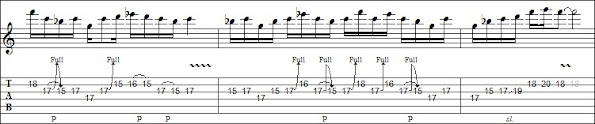
First up, the jaw-dropping slippery legato licks at the climax of "Little Wing". Both of these use the E blues scale, and notice the skilful use made of the b5 interval, the hallmark of the blues scale as opposed to the minor pentatonic.


Notice the "overlapping" approach SRV uses to get maximum mileage out of this simple scale - you've got the finger roll from the 3rd fret B string onto the 3rd fret G (where the b5 sits), sliding down to the second and then pulled off to the open G before down to the root on the 2nd fret D, before the classic open position blues lick, 2nd fret G slid to 4th, up on to 3rd fret B and then slid back down the G and pulled off to open string. It's this overlapping repetition which SRV uses to absolutely devastating effect and puts me in mind of T-Bone Walker. Both players repeat the same ideas with slight tweaks to execution, making their point again and again.

The first lick uses open position E Blues, the second example takes the same ideas and pushes them up an octave - one thing to note is how the run ends on the 5th, very much a "leading" tone - whereas the root note provides a satisfying conclusion, the 5th says "hold on, there's more to come".


The third lick comes from "Love Struck Baby", using the A Blues scale and this time is played almost exclusively in double stops - this is because the song itself is a fast and up tempo and double stops work to fill a lot of sonic space without the need for lots of distortion and legato flurries. It's also a very rhythmic approach to lead guitar, which makes sense when you consider this track was likely recorded live (legend has it that this whole album was recorded over two days at Jackson Browne's studio). Look for the classic minor to major 3rd hammer-ons that conclude the line - SRV very much channelling Chuck Berry cranked to 11!

This track was also released as a single, and just for kicks, here's a link to the video (love how they have "Lenny" playing in the background at the start):

https://youtu.be/nnbnRWHDFpw


The final example is taken from "Cold Shot" using the A Blues scale (although it should be noted that SRV famously detuned by a semitone) and although there's nothing particularly outstanding about note choice or technique, it's a very complete line, following a call - response - call - conclusion pattern. To play through this, your best bet is to keep the first finger planted on the 5th fret E and B strings using the 2nd and 3rd fingers to perform the bends, including the quarter tone bend on the high E string, bending between minor 3rd (C) and major 3rd (C#).

Don't forget to subscribe to me on YouTube to catch the demonstration video - with anything in music, it's easier to show than tell! - as well as to feast yourself on the One Minute Lick series, the beginners' Zero Point series and of course all the other Style Analysis videos.

Stay safe out there and see you next month for Mr. 335, the effortlessly smooth Larry Carlton!

Tuesday, 4 January 2022

2021 Retrospective and 2022 Resolutions

 So the dust settles on another year and although The Great Plague is not yet done with us, things are undoubtedly better than they were this time last year. Personally I've had two Astra Zenecas, a Moderna shot and a flu shot so I've practically got vaccine coming out of my ear...

This year, I've built on the success of my 2020 resolution but branched out a little – the blues greats (SRV, Hendrix, Clapton, – this time in his Cream incarnation – and the Three Kings) were still on the list but this time joined by the melodic majesty of Neil Zaza, YouTube sensations Sophie Lloyd and Pete Honore, Led Zeppelin's own riffmaster Jimmy Page, “God's Own Guitarist” Jeff Beck, and the modern day blues rock genius of Joe Bonamassa... and I've got to say, it's been a hell of a ride.

Particular standouts have been transcribing every solo off “Are You Experienced” (albeit helped by having done “Red House” in 2020), finishing all of “Texas Flood” (up till 1am with wine last night because I was damned if I was going to let the end bit of “Rude Mood” stymie me..) and at the start of December I set myself the goal of working out SRV's sublime cover of “Little Wing” which I heard and fell in love with back around 99-2000.. and from then on set the gold standard for how well the guitar should be played, as far as I was concerned. And I GOT it!!! Keep an eye on the YouTube channel for a performance (although it will be a while till I'm happy with it).

I also managed the “WOW” lick that floored me when I first heard Joe Bonamassa's cover of “Going Down” on “Live At The Greek” - and I'll admit, YouTube helped with the fingerings – but doing that keyed me into a different approach with the minor pentatonic, leading to this, “The Scariest PentatonicLick Ever?”.. so yeah, feeling pretty good about this year in guitar playing terms.

My point? Transcription is WHERE IT'S AT. Don't believe me? Try it. Take something simple, find the key, start with the appropriate pentatonic, and find those notes, just 2 or 3 at a time.

Of all of them though, the one I probably learnt most from in sheer “Oh holy SH*T THAT'S SO COOL” factor... was actually Pete Honore. Unfortunately the interview didn't quite pan out but the fact that I regularly found myself at gone midnight with the headphones on still picking out licks from his YouTube jams on the Andertons guitar channel is a testament to just how jaw droppingly good this guy is. And he hides it all in plain sight as well, there's very little overly widdly stuff... just a ton of intricacy hidden in what might seem like a simple line... BB King, Robben Ford, SRV, all combined in one hell of a player. His wide interval stuff, his use of the b5 in the blues scale and the b3 in the country scale.. put it this way – I can drive a car. Lewis Hamilton can drive a car. We both go about it the same way. The fact that Lewis could take my car and probably shave 15 minutes off a drive that normally takes me half an hour isn't down to him using different tools, it's about lots of tiny subtleties that add up to putting him in a completely different league.. and that's the same with Pete. Make no mistake about it, all the players I delved into this year are all brilliant, but there's something about Pete that just gelled with me.

Anyway, on to the future – here's the plan for 2022:


January – Larry Carlton


February – John Petrucci


March – Steve Vai


April - Joe Satriani


May - Eric Johnson


June – Ritchie Blackmore


July – Yngwie Malmsteen


August – Shawn Lane


September – Brent Mason


October – Paul Gilbert


November – SRV Pt. III


December – Slash


Some august company, I think you'll agree. The reason is simple – I'm planning to take my FLCM diploma this year and with the exception of Mssrs Blackmore & Slash, all the above feature on the performance list. So I plan to dig down into their styles a little – if you're performing (let's say) a Satriani track, you're going to do it more convincingly if you've learned a few others. And if (when) disaster strikes and it goes wrong, you're going to do a better job of improvising your way out of it if you can perform a convincing Satriani impression.

Ritchie Blackmore – well, Yngwie has often referenced Deep Purple's “Fireball” album as a huge influence on him, spending time transcribing everything off it.. so I'm going to do the same. Should help prepare me for a month of MAXIMUM SHRED. Slash? He's SLASH. 'Nuff said. You can't argue with Stoke's finest.

So where will we be this time next year? I know my guitar plans.. what are yours?

Roll on 2022. Can't wait :-)


Friday, 10 December 2021

Why I Suck... Series 2, Episode 11 - Joe Bonamassa

So, back in 2019, during the closing weeks of The World That Was, one of my students gave me a copy of Joe Bonamassa's “Live At The Greek” - I'd been aware of him for a while but had never really sat down and checked him out. Suffice it to say, I liked what I heard and “Live At The Greek” was a fixture in my car for quite a while. I also jammed along with it at home and discovered that OK, I could play some fast and widdly stuff but compared to Joe, I just.... sucked.

Now, in fairness, most players will come up short measuring themselves against someone like him, but there was something about it niggled me... the sheer inventiveness, confidence and elegance of his phrasing.. this wasn't something you could learn by pounding up and down scale patterns with a metronome. And then it hit me – Bonamassa had spent years picking out the licks of the Kings, T Bone Walker, Hubert Sumlin and co by ear, whereas I.. hadn't. I'd skipped a crucial part of my education. And this made me rethink the blog as a practice tool – by learning to transcribe the licks of these pioneers, I would learn phrasing and feel, become a better and more well rounded player.

It's worked. And I've truly fallen back in love with the guitar these last two years, discovering the joy of getting inside the heads of guitarists I've long worshipped and discovering exactly what Jimi or BB or Clapton were trying to communicate – intangible things that sheet music simply can't communicate. So in the unlikely event that Mr. Bonamassa is reading this – I owe you a debt of gratitude.

Right, onto the man himself! Born in New Hartford, New York just a mere six months before me (so we've both outlived Freddie King), young Joe didn't wait until he was 17 and instead got started at the age of 4. By the age of 11 he was being mentored by the insanely gifted and tragically departed Danny Gatton (who is yet another candidate for a spot on the blog), by 12 he was opening for B.B. King – I think by that point I'd managed to master “Cockles & Mussels Alive Alive O” on my very first nylon string. A cautionary tale indeed. Start early and go hard to achieve greatness! By 18 (when I managed a shambolic, under rehearsed gig at a sixth form prom in Long Clawson), Bonamassa was playing in a band named Bloodline – featuring the sons of jazz legend Miles Davis, Doors guitarist Robby Krieger and Allman Bros bass player Berry Oakley. His first solo album debuted in 2000 (in fairness, mine debutedv1998, but it was AWFUL and was made entirely on cassette on a Tascam 414, whereas Joe's was recorded at Pyramid Studios in New York.. and I doubt Joe is as embarrassed by his as I am by mine!)

Live At The Greek, where all of these examples are drawn from, was recorded in August 2015 and released in 2016, at the finale of the Three Kings tour – a tribute to the music of BB, Freddie and Albert King and I heartily recommend it to any fan of blues or just guitar playing in general as Joe really goes to town, stretching his legs with some absolutely sublime playing.. so let's get to business and steal some licks!


This first comes from Freddie King's “Love Her With A Feeling” using the Bb blues scale, and notice the artful use of the quarter tone bend between minor and major 3rd and the slippery slides into the b5 (E in this key) on the 9th fret G and 7th fret A strings, as Joe echoes himself in a lower octave- like Hendrix last month, there's a lot of micro-scale “storytelling” here, continuation of theme.


This is drawn from the gospel standard “Ole Time Religion” again in Bb and stands as a brilliant example of how to keep your nerve at a very high tempo and stay melodic! Joe is using Bb major pentatonic (R 2 3 5 6 -although he does tweak the ear with the odd b3 in paces) but what is noticeable here is his skilful use of the 4th (Eb) on the 16th fret B – outside the major pentatonic, and often a bridge note between major and minor, the way he integrates it into a pretty standard “magic 3 notes” lick is beautiful and as always – even at this tempo – he makes it sound absolutely effortless.


Here we have a lie from “Sittin' On The Boat Dock” in C# and shows an interesting approach using position 3 of the minor pentatonic and introducing the 2nd, creating a hexatonic scale (also used by Eric Johnson, among others) and cycling through the pattern using a slight rhythmic offset that tricks the ear into thinking that there's more going on than actually is there! Introducing the 2nd to the minor and the 4th to the major pentatonics creates a cool hexatonic effect that's actually pretty easy to begin integrating into your own playing.


The big one! This is the absolute monster, jaw-drop “how the hell did he do that” lick from “Going Down” and Joe is absolutely pedal to the metal here – this is in D minor pentatonic and Joe again starts from position 3 using the magic 3 notes again but stretching out to the 20th fret on the high E with the little finger, effectively “stealing” a note from position 4 before slithering down through position 2 into position 1 – note also the 3rd finger roll down from 13th fret B to 13th fret G (b5), sliding down to 12th and pulled off to 10th, a move heavily associated with Stevie Ray Vaughan – finishing off with alternating between the 5th (A) on the 10th fret B and root on the 10th fret high E. Wow.


So there we go, a brief look at the approach of a very formidable, very complete guitar player who I have learned a LOT from this month. Next up, we return to SRV and I'm attempting to transcribe what I consider the greatest piece of guitar playing ever - but before that, I need to do some practice before putting the YouTube demo video up....


Friday, 19 November 2021

Why I Suck.... Series 2, Episode 10 - Jimi Hendrix, "Are You Experienced"

 Winter is upon us (nearly) and as the nights begin to draw in I set myself the task of transcribing every solo off Jimi Hendrix's iconic first album, “Are You Experienced” - and I'm pleased to say I just squeaked across the finish line, in no small part having already done “Red House” last year.

We've already looked at Jimi's early history, so we'll pick up his story in Greenwich Village, New York in 1966. This was where he would meet Animals bass player Chas Chandler, playing the Cafe Wha? with his band Jimmy James & The Blue Flames – the two first met in July, but Chandler was so impressed with the young American that he returned in September with the intent of signing him. Chandler persuaded him to com e to London, and after a series of auditions settled on Noel Redding and Mitch Mitchell on bass and drums respectively. During this time, Jimi saw Cream at London Polytechnic and sat in for a couple of numbers, including Albert King's “Killing Floor”- which left a deep mark on their regular guitarist, Eric Clapton.

Their first single together as The Jimi Hnedrix Experience (Chandler having convinced Jimi to change the spelling of his name to make it more exotic) was “Hey Joe”, a cover by US folk singer Billy Roberts, which stayed in the charts for ten weeks, peaking at No. 6, and was quickly followed by the release of “Are You Experienced” which would go on to be one of the most popular and iconic rock albums of all time- and that's where we leave the history this month! Let's dive in and check out some of the licks and solos from this album.

This first is the entire solo from “Fire” and although not particularly technically challenging, it's interesting to view from the standpoint of structuring – the howling unison bend on the E that kicks off each phrase provides the “call”, and then Hendrix develops the response from phrase to phrase. Notice that both the first and the last phrases finish on a heavily vibratoed G note.


The next lick is the conclusion run from the end of “Foxy Lady”- having run through a series of screaming string bends, creating tension (“pulling back the spring”), Hendrix releases it with this run down the F# minor pentatonic. Note the “Magic 3 notes” at the heart of this, as well as the harmony bend and the rhythmic motif in the midst of this – there's actually fewer notes here than you might think, Hendrix making excellent use of space. This one is easier to show than tell, so wait for the YouTube demonstration video where I'll walk this one through!


Next, this comes from the solo to “Highway Chile” in E minor pentatonic. This is another exercise in motif development – taking the basic form of bending the 14th fret G, then picking 12th fret on the B and E strings and bending the 15th fret B. This pattern underpins the solo and Hendrix milks it expertly to create a very lyrical, musical solo.


Something a little different for our last lick – this is from Waterfall, using the A major scale (although on the recording Hendrix is detuned by a semitone) and the entire thing is played along the G string, using slides, hammer-ons and pull-offs to smooth out position shifts. This is entirely different to the first position pentatonic approach we've seen in most of these solos and shows just how well he was able to feel the intervals horizontally across the guitar neck as well as just firing off pentatonic runs. Interestingly, Hendrix gravitates to the C#, the 3rd of the I chord, and G#, the 3rd of the V – this targets the emotional core of the underlying chord and helps to create something that fits the ballad feel of the song.


So that's another one off the list! I must admit, going back to my roots here (I had this album on cassette when I first started playing...) has been a LOT of fun, filling in some blanks and giving me a new appreciation for the sheer musicality and agility of Hendrix's playing. We'll come back to him to take a look at Axis: Bold As Love next and chart the development of his playing as his career moved forward.

Stay safe and sane out there, see you for the YouTube demonstration video... and next month, the chap who gave me the metaphorical kick up the arse I'd been needing for a long time, Joe Bonamassa!