
Thursday, 29 July 2021

Tuesday, 20 July 2021
Why I Suck... Series 2, Episode 6 - BB King Pt. II
Another month, another deep dive into the legendary King Of The Blues. We've already covered the extraordinary life and times of Riley B. (aka “blues Boy” or “BB”) King in last year's blog, so here we'll limit ourselves to another in-depth look at his style. Last year's entry was focused on the legendary “Live At The Regal” album, but this time I've cast the net a little wider and gone through my “Best Of” album to take a look at examples from both the earlier and later parts of his career.
Let's start with an early example – BB got his start as a gospel singer and guitar player and this example, taken from “I'm Working On The Building” features some beautiful jazz tinged soloing (it also features a nifty use of diminished chord and an interesting turnaround that I think Showaddywaddy might have pilfered – more on that in a moment!). This track is in C and we're based on the major pentatonic with a healthy dose of chromaticism to spice things up:

Play this at speed with a swing rhythm and notice the great sense of resolution as you come off the G at the 15th fret E string to the C on the 13th fret B string – from the 5th to the root, a mini V-I perfect cadence. The chord sequence to this song also merits a look, as it's an interesting divergence from a regular 12 bar blues:
// C / C / C / C / F / F / G / G / C / C / F / F#dim / G Am / Dm G / C F / C G //
Notice the interesting use of the #IVdim as a chromatic passing chord between the IV (F) and the V (G), as well as the turnaround – V vi ii V I IV I V . This is a deft use of relative minors in the Am and Dm chords being substituted for their relative majors, C and F. Without the relative minors the turnaround becomes / G C / F G / C F / C G / - not exactly unpleasant, but a bit bland, and the use of relative minors for chord substitution show an interesting evolution here, blues based players and composers trying to evolve the 12 bar template without getting rid of it completely. You'll also find that turnaround used in Showaddywaddy's “Under The Moon Of Love”, which is played at EVERY WEDDING EVER (or so it seems).
An interesting note choice which crops up quite a bit in BB's soloing is his use of the b6 interval, bent up into the b7. This would technically fit nicely inside a minor blues but he manages – apparently by sheer force of will and charisma – to make it fit over a major key one too, and this cadenza lick from “Payin' The Cost To Be The Boss” is an excellent example of this. This is in the key of Bb (a sop to the horn section, I would imagine) and starts off on the Gb (b6) bending into the Ab (b7), followed by a quirky first finger bend on the 11th fret E (Eb bent to F 4th to 5th) , includes the major 6th (G) on the rundown and ends with his characteristic “stinger” high root note on the 18th fret high E (see last year's entry for more on that technique).

This last example is a big one, as it deals with BB's use of the major 6th in a turnaround. This example is from the Blues Collection recording of “You Done Lost Your Good Thing Now” in A, and listen to how skilfully he uses the 6th (F#) to imply the V chord. I've tabbed out the entire turnaround section, and things to look out for are the use of the E bent up to F# (5th to 6th), interplay between minor and major pentatonic, minor and major 3rds, and the use of the 3rd (C#) and 4th (D) played to imply a sus4 to major resolution. It's just FULL of BB-isms, including it's resolution to the E, the 5th, giving a sense of purpose – now we've introduced the song, pay attention as we go into the first verse!


This is the second look at BB King and as before I've come away with a sense of awe that he could be so unique and so inventive with really very basic tools at his disposal. Although we've delved a little into tsome of the nuts and bolts of his note choice there is so much of his style that realy defies quantification and explanation, so I urge you to pull out any of his material you might hae – or hell, go nuts and buy yourself a copy of one of his many Greatest Hits collections – and see what you can pick out yourself, there's a reason so many great players in their own right (looking at you, Pete Honore) list him as a key influence.
See you next month for “God's own guitarist”, Jeff Beck!
Friday, 18 June 2021
Why I Suck... Series 2, Episode 5 - "Danish" Pete Honore!
If you have a guitar and a YouTube, you've almost certainly stumbled across the internet phenomenon that is the Andertons TV YouTube channel and it's panel of hugely talented and entertaining product demonstrators. Typically, I was late to the party, having only found them in 2019 when I began researching a replacement amp for my dear old much loved but insanely heavy Laney TT50 combo. The two demonstrators, Danish Pete & Rabbea Massad, effectively sold me on the Katana and when I went and tried it in the flesh and blew the competition straight out of the water.. and even with the 100w 2x12” version, after years of lugging 30+ kilos of Laney around it felt like I could pick it up and juggle it!
(Full disclosure – I didn't actually buy it from Andertons, I got it from PMT in Nottingham, because the staff there were very patient bringing me amp after amp for a good 2-3 hours letting me try them out.. I could probably have saved £20 by getting it from Amazon but if we all do that then very soon we won't have any music shops at all, so let's think about the long game when shopping for gear...)
After this I effectively became an Andertons junkie – and if you're reading this, chaps, then “The Captain Meets... Neil Zaza” NEEDS to happen – and having thoroughly enjoyed my dues paying with the classic blues greats throughout 2020 I decided to expand my palate for 2021 to include anyone and everyone I happened to enjoy. So, over the next coupe of years all the Andertons team will be featured in the blog. I decided to start with “Danish” Pete Honore as there was something in his jazz & country tinged blues style that I connected with... another case of “He's just like me... but better!”
First a little potted history – for more details on Pete's life, career and country of origin check out this YouTube interview on the Andertons channel – and a little bio on his website here: https://www.mrpeterhonore.com/about. Born in Copenhagen, Pete received his first guitar aged 11 and was shown the A, D & E chords by a family friend. This sparked an interest and the same family friend would go on to teach him how to play Blackbird, and from then on Pete was hooked! This natural ability, plus a lot of dedication and practice, would see him move to a music academy in Copenagen, and to cut a long story short a little being in the right place at the right time coupled with a LOT of ability quickly saw him move from playing in cover and tribute bands to playing at the Brit Awards with Tom Jones in 2003. This was the breakthrough gig that saw Pete move into session work, touring with multiple chart topping bands like Girls Aloud and Il Divo before the rigours of balancing touring commitments alongside family caused him to seek more stable employment – which in it's turn led to Andertons, and YouTube stardom!
Every single blog entry since I've started doing this has said that the minor and major pentatonic forms the basis of whatever player I've been looking at's style, so I think we can take that as read.. but actually Pete tends to favour the blues scale, the minor pentatonic with a b5 added (R b3 4 b5 5 b7). Just as you can move the minor pentatonic shape three frets back to get the major pentatonic (R 2 3 5 6), you can do the same with the blues scale pattern - in this instance the b5 in the blues scale becomes the b3, giving what's often called the “country” or “major blues” scale, consisting of R 2 b3 3 5 6. There's an absolute truckload of ingenuity and musicality in Pete's playing, so let's get to it!
The licks that follow come from “The Captain Meets... Danish Pete” interview jam – and when you consider that everything transcribed here came from a two improvised solos, it's even more impressive!
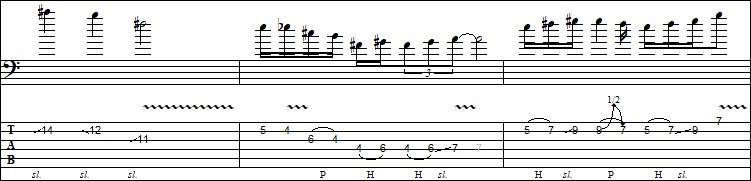
This first is in E major, leaning heavily on the 4th (A), and using a beautiful lateral move along the B string, moving from the root E on the 5th fret hammering onto the 7th fret F# (2nd), sliding into the G# (3rd) and with a wonderfully languid semitone bend to include the A (4th) and ending on the B (5th) – as with the Albert King Lick (remember that?), ending on the 5th gives a powerful sense of leading somewhere.

About 20 seconds later into the same solo, Pete hits the accelerator and pulls out this blistering little E major pentatonic run. It's largely fours – based, but far from being a straight up shred pattern there's a lot of clever stuff going on here, hidden in plain sight. He burns his way up position 1 of the C#m pentatonic shape (C#m is relative minor to E major, so this gives us a major pentatonic sound) before deftly slipping into position 5, then back into position 1 and he's running down in groups of 5 played across a 16th note (4 to the beat ) rhythm, before resolving, unusually, to the C# (6th). This is not a particularly strong tone to resolve to, but what he's actually doing is setting up tension to resolve in the next lick:

Scooting around the nether regions of the C#m scale to begin with, Pete makes deft use of hybrid picked 6ths on the A and G strings, before a slide/ pull off manouevre resolving to the 5th, which he then echoes to resolve to the root E on the 2nd fret D string. Never overtly showy, nevertheless his playing is full of this type of musicality.
Later on, in the end jam section, the key switches to G and here Pete flexes his country chops with a neat hybrid picked idea involving the open D and G string with the middle and third fingers while the plectrum picks a riff from G minor pentatonic (position 5)

This isn't particularly tricky to do, it's just yet another cool little idea Pete uses that I hadn't come across before. Try this on a bridge single coil with a Fender-style twang and it's pure Nashville!
However fast forward 20 seconds and he's gone full on jazz!! Check this out:

G Blues scale, zipped through with pull offs and slides to smooth out the transitions and check out the chromatic notes on the E string! Also, note the nifty position shift to include the b5 (Db) on the 14th fret of the B string.
I could wax lyrical about Pete's playing for pages but at some point I have to respect the fact that this is a blog post not a novel, and with that in mind this is the final lick (you can find more on the YouTube channel in the One Minute Lick playlist) – but we're ending on a high:

Starting up in G major pentatonic, this nods to the minor by bending 2nd to b3, before nimbly skipping across to position 1 of G Blues and then finishing with a sequence of 10ths picked with plectrum hitting the A string and middle finger plucking the B. If you're not familiar with the concept of 10ths, basically a 10th is what you get when you take the 3rd of a chord and boost it up by an octave. Pete further puts his own stamp on this by bending each 10th up a quarter tone to sit in between major and minor, and moves from a scalic progression in the 3rd bar of the lick to a chromatic one in the 4th.
And with that, we wrap things up – I did have lofty ideals of doing an interview but unfortunately that's not proved possible at time of writing – I'm guessing juggling a pretty intensive work schedule coupled with three kids doesn't leave a whole lot of time for stuff like that! Respect due though, I've chatted a little with both Pete and his wife on Instagram and they do seem genuinely nice people. And let's be honest, it's a crazy old world out there and as far as they know I could be a stalker or God knows what, so I do appreciate the time taken, and if the opportunity to do an interview or something similar crops up, I've got my research all done and ready!
I'll end with a link to Pete's YouTube channel and just in case you've been living under a rock, the Andertons' channel too – I believe he has plans in the pipeline for some recording and I wish him all the best with it, this has been a absolute blast learning these licks. Very educational and hugely enjoyable!
Links:
Facebook: facebook.com/mrpetehonore
Instagram: @mrpetehonore
YouTube: youtube.com/user/peterhonore
Next month – the One King To Rule Them All..... oh yes. Mr. Riley B. King, other wise known as “Blues Boy” or B.B. King steps up for another shot. Get that tux pressed and dust off the 335...
Thursday, 27 May 2021
Wednesday, 19 May 2021
Why I Suck... Series 2, Episode 4 - Freddie King Pt. II!
And we revisit the Palace Of The King! In the original article I gave a potted history of Freddkie King's life and career, so we won't belabour that here... suffice it to say that by the time he was my age at the time of writing, Mr. King had 7 kids and been dead for a year, and it's hard to think that the two things weren't intertwined... and of course his habit of substituting Bloody Marys in lieue of actual meals can't have helped... anyway, let's dive straight into the style!
As a primarily pentatonic player, one of the key facets pf Freddie's style was an ability to deftly switch between minor and major pentatonic – I think one of the best examples of this comes in his “pop” hit, “I Would Rather Be Blind”, where he moves between G minor pentatonic for the fills in the verses and switches to E minor- the relative minor of G major – fo rthe bridge section, and he takes a lightly more elegant approach than simply shifting everything three frets back:
As you can see, the minor pentatonic (R b3 4 5 b7) and major pentatonic (R 2 3 5 6) do share some notes – the root and 5th. Not just that, but the 2nd and 6th – the “sweet” notes – are located just a semitone below the b3 and b7 in the minor pentatonic, and the major 3rd can be accessed by bending the 2nd up a tone.

Another noticeable aspect of his style is the way he would “change gear” by shifting to different pentatonic shapes – generally he would use shape 1 to create fills around the vocal, before moving to shape 2 to begin the solo. However, he doesn't always stay there – there's a nice contrary motion effect he gets by moving from shape 2 to shape 1 when the chord sequence moves to the IV. Check out this lick from “Me & My Guitar” to see this idea in action:

This lick works by targeting the 5th of each chord – bending the A up to a B over the E chord, and then D up to E over the A chord, finishing up with a quarter tone tweak in between minor and major 3rd over the E chord.
There's some neat turnaround work in the same track, following the chord pattern – B7, A7, E7, B7 – outlining the arpeggios and with some chromatic passing notes thrown in and using the open E minor pentatonic with a healthy dose of major 3rd added.

An often overlooked part of Freddie's technique was his use of hybrid or fingerpicking to access wider interval jumps across strings, and there's an interesting example of this in “Just A Little Bit” - jumping from the D to the B strings and back again, before faking you out a little bit... just when you think he's about to resolve to the root (Bb) on the low E, he instead reaches out with his pick hand middle finger to pick the high E instead. It's a really interesting, quirky effect.

The same solo ends with a neat “tension and release” scale run – a long, held bend from the b7 up to the root providing the tension, and a flurry of pentatonic triplets providing the release – think of pulling back an elastic band and then letting go! Also, check out the way Freddie would weave pre-bends into the run, as well as the bluesy aggression caused by resolving the lick to the b7 instead of the root:

So, plenty to take away and play with from this month – just remember kids, a Bloody Mary is NOT A nutritional breakfast!
Next month, an internet legend and very possibly a serious coup.. let's keep those fingers crossed....
Monday, 10 May 2021
Friday, 16 April 2021
Why I Suck.. Series 2, Progress Report 3 - Sophie Lloyd
And with a bang, we jump right into the 21st century to examine the playing style of YouTube sensation Sophie Lloyd! I first became aware of her when Guitar World did a piece on her version of“Bohemian Rhapsody” during summer 2020, and I will hold my hands up here- when I clicked on the video and was met with the image of the glamorous blonde, perfect make up etc, my inner cynic's first thought was “OK, I can see why she's popular..”
By about the fourth bar, however, my inner cynic had shut up entirely, and I was busy picking my jaw up off the floor. Now, here's the thing – when you're confronted by someone on YouTube who's a better player than you, you can either think a) “Oh, this is hopeless, I'll never be able to do that, might as well give up now” or b) “Right, let's slow that down and figure out what he/she is doing there then”. I chose “b”, and (as any of you who follow my One Minute Lick posts on Instagram will be aware) have been richly rewarded with an absolute plethora of licks and runs, which we'll take a look at in this article.
First, a little potted history - Sophie began playing guitar at a young age and reached grade 8 by age 16, drawing influence from classic rock and metal bands like Iron Maiden, Pantera and Black Label Society (a fellow Zakk Wylde fan!) and went on to complete a music degree at the Brighton Institute of Modern Music (BIMM) London, graduating with first class honours.. She released her first EP, “Delusions” in 2018, but the real source of her fame is undoubtedly her YouTube channel, where as well as gear demos and original music she performs shred versions of classic rock tunes such as “Bohemian Rhapsody” and “Highway To Hell”. Beyond that, information is a little bit sketchy, but it's safe to say that unlike most of the players we've checked out in the blog she's at the beginning of her career, rather than being firmly established like Neil Zaza or, well, dead. So one to to keep an eye on, especially as she's building up to a big release.
So, onto the juicy stuff – the licks! I'll admit to being a bit intimidated at first but when I started slowing things down and drilling down into the detail I started to decode some of the patterns she tends to favour, and like most of us, her playing is based predominantly around the minor pentatonic and position 1 three note per string major scale shapes.

A word on practicing these patterns – all too often students practice these patterns in isolation and then find they struggle to apply them. One trick to use to help here is to alternate rhythm and lead – for example , in the examples tabbed, practice chugging on a G powerchord for a bar before switching to one of the lead patterns for a bar, and then back to rhythm and so on. Make sure you keep a steady tempo whilst practicing, either with a metronome or drum machine, or just by tapping your foot. You'll have noticed that the stacked 12 pattern fits nicely into the bar, but for the 6 pattern you'll need to trim a group of 6 to make it fit the bar.


Developing these ideas further, Sophie often brings in pick hand tapping with runs like this one from her version of “Highway To Hell”, which combines the E natural minor 3 note per string fingering in the left hand while the right hand taps the A minor pentatonic at the 17th fret. The main chord in Highway To Hell is an A power chord, so this evens out as an A Dorian sound. The keen eyed amongst you will notice a rogue C# at the end, but that works out as a major 3rd over the A power chord, and of course power chords don't have 3rds in them so there's no clash. Nice.

She's also quite fond of lateral or horizontal legato runs along a single string, as in this example from her original track “After Insanity”, which is played with a five note per beat rhythm – however, this is split into a 16th note triplet followed by a pair of regular sixteenth notes, so think “1 & a 1 &” when you're counting. This run uses the A natural minor running from the G (b7) at the 15th fret to the D (4th) at the 7th fret G. Don't neglect the rhythmic elements when practicing these licks, so tap the foot firmly on each downbeat to ensure you're grounded.

As well as these shred three note per string ideas, Sophie doesn't neglect the humble minor pentatonic, and a couple of tricks she likes to use include string skipping, like this lick in “Highway To Hell” using position 1 of A minor pentatonic at the 17th fret:

And she's not afraid to move laterally around the fretboard, as this lick from “Bullet Proof Revolver” shows, moving across the B string, starting in position 1 and then moving through 2 and 3 before finishing in porition 4 – this lick will be familiar to anyone who's checked out my horizontal/ diagonal pentatonic techniques in Progressive Guitar Training... great minds think alike!

That concludes our examination of Sophie Lloyd's style for now, but there's a LOT more to check out – we haven't touched on her use of arpeggios, for example, or how she integrates sweep picking into her runs... but that's fine, like Neil Zaza it just gives me an excuse to revisit! There's a lot this month that has dovetailed with my own playing – unlike a Steve Vai or Allan Holdsworth, when you get right down to the details, she plays a lot like I do.. just better! Which makes this exercise all the more rewarding.
Next month we're back to the blues, as Freddie King gets another turn under the microscope... until then, stay safe and happy practicing!