
Tuesday, 28 September 2021

Monday, 20 September 2021
Why I Suck... Series 2, Episode 8 - Jimmy Page
Whoops, just looking back at my plan it seems I got Jimmy Page & Cream-era Clapton round the wrong way.. ooops. Still, never mind, I'm sure you gentle readers out there (both of you) will forgive me..
There's a fair amount of controversy regarding some element's of Jimmy's life – largely centred around drug use, occultism and so forth – but seeing as Hello! Magazine has probably got that all covered, we're going to focus on the interesting stuff – the playing, and also the production tricks, as Jimmy was very skilled in getting the most out of the equipment of the day.
First, a brief potted history. Born January 9 1944 in London, Page moved to Epsom in Surrey aged 8, entering the legendary “Surrey Delta” that also included Eric Clapton and Jeff Beck. When the family moved to their second house in the area, on Miles Road, Jimmy (now 12) discovered an old Spanish guitar, possibly left there by a previous owner, and inspired by Elvis Presley – in particular the song “Baby Let's Play House” began to play in earnest, devoting as much as six or seven hours to practice. His tastes expanded to include the skiffle craze (proto-rock & roll for British kids with no money to buy expensive instruments, essentially) that swept the UK in the early-mid '50s as well as the Chicago blues of players like Freddie & B.B. King – but interestingly, he always kept an affection for traditional folk music, something that would come to the fore frequently in his later years with Led Zeppelin.
Now, I would be remiss if I didn't include this famous clip of a VERY young Jimmy Page's first television appearance:
His teenage years followed largely the same blueprint as most British guitar heroes of the time – art college (where he met and befriended Jeff Beck) and although he never joined John Mayall's Bluesbreakers, he did spend time as a member of the Yardbirds, which seems to have served as something of a finishing school for guitar heroes during this time, Clapton and Jeff Beck both having been members. However, while still a student, a young Jimmy was busy taking every gig he could get and was spotted by singer Neil Christian and asked to join his band, The Crusaders. Now 15 years old and having left school with 4 O levels with the intent of pursuing a career in music, this seemed like the perfect break but unfortunately an attack of glandular fever put paid to that- and if you've ever suffered from that yourself, you'll understand why.
Page kept playing through his recovery, and was spotted by John Gibb of the Columbia Gramophone Company who asked him to come and play on a few recording sessions with The Who and this break set him on the road to becoming an early unsung guitar hero of the 1960s along with Big Jim Sullivan (who I think deserves his own entry one of these days...) as he fast became the favoured session guitarist of legendary producer Shel Talmy, who was responsible for producing albums by The Kinks and The Who. Page played on a wealth of recordings by them and various other artists (including, incongruously enough, “Downtown” by Petula Clark) – in 1965 he was hired as a producer by Rolling Stones' manager Andrew Loog Oldham for their newly formed label Intermediate Records, and would have likely continued down this career path had it not been for the increasing influence of Stax Records on the popular music scene, which meant the phasing out of guitars in favour of brass and string arrangements.
Growing dissatisfied with this, Page reached out to the Yardbirds, who as early as 1964 had been in touch with him as a potential replacement for Eric Clapton. Now with Jeff Beck playing lead guitar, bass player Paul Samwell-Smith quit the group and Jimmy took up his slot. It didn't take long before rhythm guitarist Chris Dreja took over the bass slot and allowed Jimmy to play dual lead with Jeff Beck – understandable enough, I think I'd have done the same thing in his shoes...
Jimmy recorded the album Little Games with the Yardbirds and although it wasn't particularly successful the group had tour dates booked to promote it. However, singer Keith Relf and drummer Jim Mcarty both quit the band, leaving Page with the contractual problem of having a tour booked and no band! So, reaching back to an idea he'd had in 1966 whilst recording the single “Beck's Bolero” with Keith Moon, John Paul Jones and Nicky Hopkins, he decided to put together a new group building on the heavier and more experimental aspects of The Yardbirds... fellow session player John Paul Jones was duly recruited to cover bass and any keyboard duties, and the Birmingham duo of Robert Plant and John Bonham took on vocals and drums respectively and The New Yardbirds was born. Over the course of the tour the name was changed to reflect a joke Keith Moon had made during the “Beck's Bolero” recordings, that a supergroup made up of them all would “go down like a lead balloon” - the group took on the moniker “Lead Zeppelin”, changed by their manager Peter Grant (in order to avoid mispronunciation) to “Led Zeppelin”.
And that is where our history lesson ends – let's get stuck in to some licks!
This first is the iconic opening to “Stairway To Heaven” - at first glance this might seem like a pretty stock “bend and widdle” tension and release idea using A minor pentatonic, but check out the last note – F. Jimmy moves outside the minor pentatonic to target the root note as the chord sequence moves Am- G – F. So simple, but so effective.

Moving on, the next example comes from one of my all-time favourite solos, “Since I've Been Loving You” from Led Zeppelin III – this is based on a 12 bar blues sequence in C minor, and was recorded as something of a middle finger to the music press that had lambasted Led Zeppelin for being all bombast and no depth, this song is a masterclass in dynamics and music as cinema. Using the C natural minor scale, Jimmy plays this line over the IV chord (Fm) which plays heavily on the D and Ab notes, 2nd and b6th but which over the Fm sound as 6th and b3rd, giving something of a jazzy Dorian vibe.

I couldn't do a piece on Jimmy Page without looking at some of the fast repeating licks which dazzled me as a beginner delving in to the world beyond Oasis and Nirvana, and to that end, here is the beginning of Communication Breakdown from Led Zeppelin I, played on the recording with a wah wah pressed down into full treble position. You can see how Jimmy uses the “Magic 3 Notes” plus the 12th fret E creating a fast cycling blistering effect that hits you like a freight train straight out of the blocks.

Last up, this is from “Good Times, Bad Times” (again on Led Zeppelin I) – another E minor pentatonic blitz that had my beginner's jaw dropping. Initially I though this was going to be a simple E minor pentatonic sequenced in threes, but listening more intently and slowing it down I discovered that it's a little more involved than that, as he makes clever use of the C# on the 11th fret D string “sweetening” the sound slightly and giving it a Dorian/ Mixolydian vibe that's subtly different from just the minor pentatonic. Take this one, practice each beat individually before putting it all together and take note of the overall sequenced in threes pattern.

I've thoroughly enjoyed this deep dive into these classic solos, it's surprising just how much of an influence it's had on my playing – even though I hadn't really listened to any Zeppelin for a while, straight away it took me back to my early days and being able to pull apart and transcribe these Holy Grail solos has been an absolute blast!
Next month we're revisiting God himself, in his 2nd incarnation – get ready for some Cream!
Thursday, 19 August 2021
Thursday, 12 August 2021
Why I Suck... Series 2, Episode 7 - Jeff Beck
“Jeff's great, man. He's God's own guitar player”.
Thus spake Toto guitar legend Steve Lukather in an interview for Guitarist magaine way back when. And frankly, he's got a point – I remember getting the goosebumps when I first heard “Cause We've Ended As Lovers”, and being completely obsessed with the track, performing my own – probably hamfisted – version as my first performance piece at music college. Those eerie, poignant intro bends, the languid melody, the sheer disregard for anything resembling scale shapes, just chasing the melody down wherever it might lead you on the fretboard... I was hooked.
Of the Big Three of 60's British blues greats – Jeff Beck, Jimmy Page and Eric Clapton – it's Jeff Beck that has had arguably the most checkered of careers.Whilst EC is still going strong, if somewhat erratically, and Page has had his years of world domination with Led Zeppelin and it's various offshoots and descendants, Beck has always been something of an outsider, never quite reaching the levels of the other two. To be fair, he's not exactly languishing in obscurity, having twice been inducted into the Rock & Roll Hall of Fame, earned eight Grammy awards and sessioned with the likes of Stevie Wonder, Tina Turner and Bon Jovi – but while everyone has heard of Clapton, and everyone knows about Zeppelin, Beck has never made it to the mainstream in quite the same way, remaining the guitarist's guitar hero.
My initial exposure to him was actually through this:
Yep, Lenny Henry, singing the blues! Check out the intro solo though – THAT got my attention.
So, before we dive in to some licks from this quirkiest and most distinctive guitarist, a little history. Born June 24 1944 in Surrey
– the same “Surrey Delta” which produced Clapton and Page at
around the same time – Beck's career followed a similar path,
falling in love with the sound of an electric guitar after hearing
Les Paul playing How High The Moon on the radio aged 6 and building
various instruments of his own to try and replicate what he saw and
heard. It's important to note that during his childhood and much of
the 1950s, the UK was in tatters with wide ranging poverty and
rationing still continuing for several years post-war. These were
emphatically NOT the “boom times” that the USA was enjoying
during the same period, the UK was a grey, miserable, poverty
stricken place trying to recover from the enormous damage and cost of
fighting WW2. An electric guitar, in these times, was as far out of
the reach of most regular families as a Ferrari is now. So it's worth
remembering that while we might scoff at the idea of white kids from
Surrey having anything in common with the black musicians of the
Mississippi Delta or Chicago, at that time both were coming from a
place of deprivation, poverty and desperation.
As with many musicians, Beck went on to art college – specifically, Wimbledon Art College where he met Jimmy Page. During this time he was playing with many local covers bands and got a first taste of session work in 1964. In 1965 he went on to replace Eric Clapton in The Yardbirds – the group had turned away from the traditional blues that Clapton was interested in and started to become more pop-orientated with the release of “For Your Love”. The group had originally wanted Jimmy Page but at that time he was busy with session work so suggested his old mate from Wimbledon Art College, Jeff Beck.
His time with the Yardbirds was short – 20 months – but intense, including the recording of the instrumental “Beck's Bolero” which featured Jimmy Page on rhythm guitar and John Paul Jones on bass as well as The Who's Keith Moon on drums, and Page would join the Yardbirds initially on bass but subsequently as second lead guitarist, and the two featured in the 1966 film “Blow Up”. However, Jeff Beck at this point proved himself no easy person to work with – tales abound of relentless perfectionism, explosive outbursts and flat out not showing up to gigs which unsurprisingly led to him being fired from the band in 1967.
From here began the first tentative steps at a solo career – first as a session guitarist for the infamous pop producer Mickie Most, ironically producing probably his most successful foray into mainstream pop music – Hi Ho Silver Lining. Yes, that's Jeff Beck playing the solo. And no, I won't be tabbing it out here.
The next big step in his career was the formation of the Jeff Beck Group, featuring Rod Stewart on vocals, Ronnie Wood on bass, Nicky Hopkins (who had taken part in the Beck's Bolero recording) on piano and Aynsley Dunbar on drums. Rod Stewart and Ronnie Wood would later go on to form The Faces before going their separate ways, Ronnie joining The Rolling Stones and Rod Stewart... well, you all know who Rod Stewart is.
They released two albums “Truth” (1968) and “Beck-O-La” (1969), the former containing a cover of Willie Dixon's “You Shook Me” strikingly similar in arrangement to the version that would appear later on Led Zeppelin I. However, everything came to a halt in December of 1969 near Maidstone when Beck was involved in a terrible car accident and fractured his skull.
Moving into 1970, having rehabilitated and returned to health, with the help of Mickie Most, Beck set about forming a new Jeff Beck Group. He flew to the US and recorded several tracks at Motown Studio A with the help of various US session musicians and they toured briefly as “The Jeff Beck Group” but this new incarnation had a very different sound from it's previous one, much more towards a funk vibe. Beck recruited bassist Tim Bogert and drummer Carmine Appice and the band morphed into “Beck, Bogert & Appice” as a power trio – this lineup recorded a proto-heavy metal cover of Stevie Wonder's “Superstition”. However, they never really broke through commercially and dissolved in 1974, which is where we get to his first true solo album, “Blow By Blow” in 1975 which is where I took most of my examples from. This had much more of an exploratitive jaz-rock feel, as did it's follow up, “Wired”, released in 1976.
We'll leave the history there and start an exploration of Jeff's style from around this period.
This first example is from Freeway Jam in G (G Mixolydian to be exact) and illustrates his quirky and explorative approach to the minor pentatonic. Note the howling and aggressive harmony bend that starts it, the heavy use of quarter tone bends going between minor and major third, the chromatic passing tones (6, b6 and b2) finishing with an unusual bend on the b7 (F) into the root on the low E string.

The next examples are taken from “You Know What I Mean” on Blow By Blow, which at least starts in B minor but is pretty wide open harmonically. Beck uses a series of major and minor 6th intervals, relatively common in blues and country music before morphing into what is more or less an F dominant 7 arpeggio, with the 6th and minor 3rd involved as passing notes.

The next example is broadly based in G minor pentatonic and with a variety of chromatic notes used to spice it up. 2nd, major 3rd, 6th. There's some seriously complex stuff going on here so take it slow, watch for repetitive patterns. Jeff had his foot well and truly to the floor for this one.

This last is the conclusion to the previous line , and notice anything? Amidst all the blazing repetition and howling harmony bends, can you spot our old friends, the Magic Three Notes? That's right, even the big boys use them too! One final touch, Beck resolves to the root note, but an octave lower than where the rest of the lick takes place – those wider intervals represent another quirk of his playing that marks him out.


It's been a thoroughly enjoyable journey investigating this leftfield take on the conventional blues rock licks, and I've no doubt I'll be revisiting this iconic guitarist again sooner or later... there'll be a YouTube video demonstrating these licks along shortly so make sure you're subscribed! Meantime , stay safe out there and tune in next month for Led Zeppelin's own riffmaster, Jimmy Page!
Thursday, 29 July 2021
Tuesday, 20 July 2021
Why I Suck... Series 2, Episode 6 - BB King Pt. II
Another month, another deep dive into the legendary King Of The Blues. We've already covered the extraordinary life and times of Riley B. (aka “blues Boy” or “BB”) King in last year's blog, so here we'll limit ourselves to another in-depth look at his style. Last year's entry was focused on the legendary “Live At The Regal” album, but this time I've cast the net a little wider and gone through my “Best Of” album to take a look at examples from both the earlier and later parts of his career.
Let's start with an early example – BB got his start as a gospel singer and guitar player and this example, taken from “I'm Working On The Building” features some beautiful jazz tinged soloing (it also features a nifty use of diminished chord and an interesting turnaround that I think Showaddywaddy might have pilfered – more on that in a moment!). This track is in C and we're based on the major pentatonic with a healthy dose of chromaticism to spice things up:

Play this at speed with a swing rhythm and notice the great sense of resolution as you come off the G at the 15th fret E string to the C on the 13th fret B string – from the 5th to the root, a mini V-I perfect cadence. The chord sequence to this song also merits a look, as it's an interesting divergence from a regular 12 bar blues:
// C / C / C / C / F / F / G / G / C / C / F / F#dim / G Am / Dm G / C F / C G //
Notice the interesting use of the #IVdim as a chromatic passing chord between the IV (F) and the V (G), as well as the turnaround – V vi ii V I IV I V . This is a deft use of relative minors in the Am and Dm chords being substituted for their relative majors, C and F. Without the relative minors the turnaround becomes / G C / F G / C F / C G / - not exactly unpleasant, but a bit bland, and the use of relative minors for chord substitution show an interesting evolution here, blues based players and composers trying to evolve the 12 bar template without getting rid of it completely. You'll also find that turnaround used in Showaddywaddy's “Under The Moon Of Love”, which is played at EVERY WEDDING EVER (or so it seems).
An interesting note choice which crops up quite a bit in BB's soloing is his use of the b6 interval, bent up into the b7. This would technically fit nicely inside a minor blues but he manages – apparently by sheer force of will and charisma – to make it fit over a major key one too, and this cadenza lick from “Payin' The Cost To Be The Boss” is an excellent example of this. This is in the key of Bb (a sop to the horn section, I would imagine) and starts off on the Gb (b6) bending into the Ab (b7), followed by a quirky first finger bend on the 11th fret E (Eb bent to F 4th to 5th) , includes the major 6th (G) on the rundown and ends with his characteristic “stinger” high root note on the 18th fret high E (see last year's entry for more on that technique).

This last example is a big one, as it deals with BB's use of the major 6th in a turnaround. This example is from the Blues Collection recording of “You Done Lost Your Good Thing Now” in A, and listen to how skilfully he uses the 6th (F#) to imply the V chord. I've tabbed out the entire turnaround section, and things to look out for are the use of the E bent up to F# (5th to 6th), interplay between minor and major pentatonic, minor and major 3rds, and the use of the 3rd (C#) and 4th (D) played to imply a sus4 to major resolution. It's just FULL of BB-isms, including it's resolution to the E, the 5th, giving a sense of purpose – now we've introduced the song, pay attention as we go into the first verse!


This is the second look at BB King and as before I've come away with a sense of awe that he could be so unique and so inventive with really very basic tools at his disposal. Although we've delved a little into tsome of the nuts and bolts of his note choice there is so much of his style that realy defies quantification and explanation, so I urge you to pull out any of his material you might hae – or hell, go nuts and buy yourself a copy of one of his many Greatest Hits collections – and see what you can pick out yourself, there's a reason so many great players in their own right (looking at you, Pete Honore) list him as a key influence.
See you next month for “God's own guitarist”, Jeff Beck!
Friday, 18 June 2021
Why I Suck... Series 2, Episode 5 - "Danish" Pete Honore!
If you have a guitar and a YouTube, you've almost certainly stumbled across the internet phenomenon that is the Andertons TV YouTube channel and it's panel of hugely talented and entertaining product demonstrators. Typically, I was late to the party, having only found them in 2019 when I began researching a replacement amp for my dear old much loved but insanely heavy Laney TT50 combo. The two demonstrators, Danish Pete & Rabbea Massad, effectively sold me on the Katana and when I went and tried it in the flesh and blew the competition straight out of the water.. and even with the 100w 2x12” version, after years of lugging 30+ kilos of Laney around it felt like I could pick it up and juggle it!
(Full disclosure – I didn't actually buy it from Andertons, I got it from PMT in Nottingham, because the staff there were very patient bringing me amp after amp for a good 2-3 hours letting me try them out.. I could probably have saved £20 by getting it from Amazon but if we all do that then very soon we won't have any music shops at all, so let's think about the long game when shopping for gear...)
After this I effectively became an Andertons junkie – and if you're reading this, chaps, then “The Captain Meets... Neil Zaza” NEEDS to happen – and having thoroughly enjoyed my dues paying with the classic blues greats throughout 2020 I decided to expand my palate for 2021 to include anyone and everyone I happened to enjoy. So, over the next coupe of years all the Andertons team will be featured in the blog. I decided to start with “Danish” Pete Honore as there was something in his jazz & country tinged blues style that I connected with... another case of “He's just like me... but better!”
First a little potted history – for more details on Pete's life, career and country of origin check out this YouTube interview on the Andertons channel – and a little bio on his website here: https://www.mrpeterhonore.com/about. Born in Copenhagen, Pete received his first guitar aged 11 and was shown the A, D & E chords by a family friend. This sparked an interest and the same family friend would go on to teach him how to play Blackbird, and from then on Pete was hooked! This natural ability, plus a lot of dedication and practice, would see him move to a music academy in Copenagen, and to cut a long story short a little being in the right place at the right time coupled with a LOT of ability quickly saw him move from playing in cover and tribute bands to playing at the Brit Awards with Tom Jones in 2003. This was the breakthrough gig that saw Pete move into session work, touring with multiple chart topping bands like Girls Aloud and Il Divo before the rigours of balancing touring commitments alongside family caused him to seek more stable employment – which in it's turn led to Andertons, and YouTube stardom!
Every single blog entry since I've started doing this has said that the minor and major pentatonic forms the basis of whatever player I've been looking at's style, so I think we can take that as read.. but actually Pete tends to favour the blues scale, the minor pentatonic with a b5 added (R b3 4 b5 5 b7). Just as you can move the minor pentatonic shape three frets back to get the major pentatonic (R 2 3 5 6), you can do the same with the blues scale pattern - in this instance the b5 in the blues scale becomes the b3, giving what's often called the “country” or “major blues” scale, consisting of R 2 b3 3 5 6. There's an absolute truckload of ingenuity and musicality in Pete's playing, so let's get to it!
The licks that follow come from “The Captain Meets... Danish Pete” interview jam – and when you consider that everything transcribed here came from a two improvised solos, it's even more impressive!
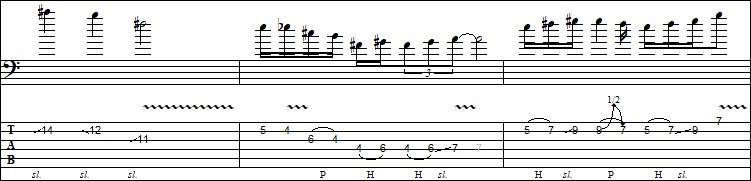
This first is in E major, leaning heavily on the 4th (A), and using a beautiful lateral move along the B string, moving from the root E on the 5th fret hammering onto the 7th fret F# (2nd), sliding into the G# (3rd) and with a wonderfully languid semitone bend to include the A (4th) and ending on the B (5th) – as with the Albert King Lick (remember that?), ending on the 5th gives a powerful sense of leading somewhere.

About 20 seconds later into the same solo, Pete hits the accelerator and pulls out this blistering little E major pentatonic run. It's largely fours – based, but far from being a straight up shred pattern there's a lot of clever stuff going on here, hidden in plain sight. He burns his way up position 1 of the C#m pentatonic shape (C#m is relative minor to E major, so this gives us a major pentatonic sound) before deftly slipping into position 5, then back into position 1 and he's running down in groups of 5 played across a 16th note (4 to the beat ) rhythm, before resolving, unusually, to the C# (6th). This is not a particularly strong tone to resolve to, but what he's actually doing is setting up tension to resolve in the next lick:

Scooting around the nether regions of the C#m scale to begin with, Pete makes deft use of hybrid picked 6ths on the A and G strings, before a slide/ pull off manouevre resolving to the 5th, which he then echoes to resolve to the root E on the 2nd fret D string. Never overtly showy, nevertheless his playing is full of this type of musicality.
Later on, in the end jam section, the key switches to G and here Pete flexes his country chops with a neat hybrid picked idea involving the open D and G string with the middle and third fingers while the plectrum picks a riff from G minor pentatonic (position 5)

This isn't particularly tricky to do, it's just yet another cool little idea Pete uses that I hadn't come across before. Try this on a bridge single coil with a Fender-style twang and it's pure Nashville!
However fast forward 20 seconds and he's gone full on jazz!! Check this out:

G Blues scale, zipped through with pull offs and slides to smooth out the transitions and check out the chromatic notes on the E string! Also, note the nifty position shift to include the b5 (Db) on the 14th fret of the B string.
I could wax lyrical about Pete's playing for pages but at some point I have to respect the fact that this is a blog post not a novel, and with that in mind this is the final lick (you can find more on the YouTube channel in the One Minute Lick playlist) – but we're ending on a high:

Starting up in G major pentatonic, this nods to the minor by bending 2nd to b3, before nimbly skipping across to position 1 of G Blues and then finishing with a sequence of 10ths picked with plectrum hitting the A string and middle finger plucking the B. If you're not familiar with the concept of 10ths, basically a 10th is what you get when you take the 3rd of a chord and boost it up by an octave. Pete further puts his own stamp on this by bending each 10th up a quarter tone to sit in between major and minor, and moves from a scalic progression in the 3rd bar of the lick to a chromatic one in the 4th.
And with that, we wrap things up – I did have lofty ideals of doing an interview but unfortunately that's not proved possible at time of writing – I'm guessing juggling a pretty intensive work schedule coupled with three kids doesn't leave a whole lot of time for stuff like that! Respect due though, I've chatted a little with both Pete and his wife on Instagram and they do seem genuinely nice people. And let's be honest, it's a crazy old world out there and as far as they know I could be a stalker or God knows what, so I do appreciate the time taken, and if the opportunity to do an interview or something similar crops up, I've got my research all done and ready!
I'll end with a link to Pete's YouTube channel and just in case you've been living under a rock, the Andertons' channel too – I believe he has plans in the pipeline for some recording and I wish him all the best with it, this has been a absolute blast learning these licks. Very educational and hugely enjoyable!
Links:
Facebook: facebook.com/mrpetehonore
Instagram: @mrpetehonore
YouTube: youtube.com/user/peterhonore
Next month – the One King To Rule Them All..... oh yes. Mr. Riley B. King, other wise known as “Blues Boy” or B.B. King steps up for another shot. Get that tux pressed and dust off the 335...