Wednesday, 10 May 2023

Why I Suck.. Series 4, Episode 4 - Eric Clapton Pt. 3 - Post-Cream

 And we are back with the guitarist known to some simply as “God” - Eric Clapton! This is actually the third instalment covering EC's playing – the first covered hisdays as a Bluesbreaker and the legendary “Beano” album, in the second we took a look at his seminal work with supergroup Cream, and so in this one we'll be taking a look at What Eric Did Next. Now, there's actually a fair bit so we'll be skipping quite a lot of detail and just picking out a few salient points on his journey to become the vastly successful solo artist he is today.

In the immediate aftermath of Cream's demise, one of his first appearances was THAT solo on The Beatles' “While My Guitar Gently Weeps”, brought in as a guest soloist as George Harrison was struggling to get the “crying” sound from his guitar that he wanted, and certainly working through Clapton's solo is heavy on the wide string bends. But the next band was Blind Faith, formed in 1969 and featuring Cream drummer Ginger Baker, Steve Winwood and Ric Grech of Family. Billed as rock's first “supergroup”, the band managed one six-song album (albeit featuring a hit single, “Can't Find My Way Home”) and a US tour before disbanding – however, Clapton had become good friends with the support act Delaney & Bonnie, and this group would evolve into the next group, Derek & The Dominoes. This is the group with which EC wrote and recorded the song he is most closely associated with, “Layla”, famously written about his infatuation with the wife of his friend George Harrison (I'm going to spoiler the lick part of this post – there isn't anything from Layla as the focal point of the guitar playing is the riff, which I assume everyone reading this can already play..).

Iconic as the title song undoubtedly is, the album itself sold poorly, and Derek & The Dominoes went the same way as Blind Faith, and this was instrumental in Clapton falling into heroin use. 

Surprisingly, this failed to solve anything. However, it fortunately proved not to be terminal, and after various interventions from friends including Pete Townshend, Clapton was able to kick the habit and get back to music, assembling a touring band with which he recorded his first solo album, “461 Ocean Boulevard” which included the hit Bob Marley cover “I Shot The Sheriff”. This was the genesis of Clapton's solo career and set him on the path he still walks now.

However, it would be wrong to include any history of Clapton that didn't mention the tragic death of his 4 year old son Conor in 1991 after accidentally falling from a 53rd floor window of a family friend's apartment in New York, inspiring the acoustic ballad “Tears In Heaven” which he performed on the “Unplugged” album in 1992, one of the first of the MTV “Unplugged” series. As well as managing to kick heroin, Clapton also struggled with alcohol abuse but impressively managed not to relapse despite this tragedy, and he runs a rehab centre in Antigua to this day.

So that's history dealt with – let's take a long at some of EC's playing through this period.


This first lick is taken from “Let It Rain”, from Clapton's self-titles solo album released in 1972. Interestingly, the song is in D major but it revolves heavily around the A chord making it more accurate to view it as being A Mixolydian (R 2 3 4 5 6 b7 – A B C# D E F# G) and in this lick Clapton is blasting A major pentatonic (R 2 3 5 6 – A B C# E F#) over the top, and you can see him utilising the “3 frets back rule” - taking the F# minor pentatonic shape (R b3 4 5 b7 – F# A B C# E) as the basis for this lick, starting in 2nd position and moving back to first. Notice the 3 against 4 idea – technically known as a “hemiola”, this places a three note melodic phrase in a four note rhythmic grouping so that each time the notes fall onto the beat in a different way, often creating the illusion of something being much more complex! Another great example of this are the fast parts of the “Alright Now” solo, or basically anything John Squire and Noel Gallagher played in the 90s..


I did say I wasn't going to put anything from “Layla” up, but on the same album is the track “Bell Bottom Blues” with some terrific and emotive playing from Clapton. This lick is tucked away right before the fadeout and features EC milking string bends from the A minor pentatonic (A C D E G) scale at the 17th fret – notice the C bent first up to D (3rd to 4th) and then just a quarter tone to in between C & C#, so in between minor and major. In the second bar Clapton performs a series of string bends on the same note, bending it up a tone, then alternating between bent and straihht, before finishing with a downward bend and a couple f howling G notes bent up to As to finsh the track off with a resolution to the root note.


In this third example we leap forward to the 80s – VERY 80s – with 1989's “Bad Love” and in the age of shred Clapton's solo is a welcome dose of good taste classic rock. This particular lick uses D minor petatonic and is based primarily around positions 3 and 4 of the minor pentatonic, and notice the “3 Magic Notes” motif – pick/ hammer/ pull, down to the next string and back up – he translates across the strings. It's a subtle thing, but these elements can help tie a solo together and provide a sense of narrative. The howling harmony bend that finishes the lick off provides a fitting climax to the run.


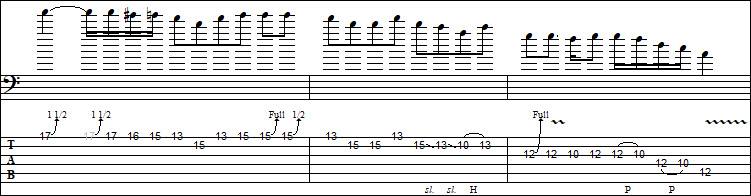
Finally we move things forward to more-or-less present day with a live version of Cocaine from 2017. This particular performance has some absolutely incendiary playing from EC and showcases his deft use of the Mixolydian (R 2 3 4 5 6 b7), both directly and by blending elements of major and minor pentatonic scales. To give some theory, E Mixolydian contains E F# G# A B C# D, whilst E major pentatonic contains E F# G# B C#, whilst E minor pentatonic contains E G A B D. When you blend them together you get E F# G G# A B C# D, so effectively getting the Mixolydian plus an additional minor 3rd (G), which EC alternates with G# to milk the blues feel.

This particular lick is an absolute barnstormer, with Clapton going full pedal to the metal here (performed with a healthy dose of wah pedal too) – note F# bent up a semitone (2nd into minor 3rd), the repetitive 3 Magic notes phrasing grouped first in 4 then in 3s to build intensity, the C# (6th) bent to D (b7th) and the quirky wide interval finger roll he performs on his way down the scale, as well as the use of chromaticism to spice up the ending, which finishes on a bluesy b7 rather than the safer root note.

I think Clapton often gets overlooked by a lot of guitarists as the “Radio 2 Guitar Hero”, the non-guitarist's guitar hero – and to be fair, tracks like “Wonderful Tonight” do him no favours there – but getting deep into EC's playing in his later days has shown me there is a lot to learn here and that the guy is the genuine article. Certainly, working through the epic live “Cocaine” solo was something of an eye opener as you really could feel like Clapton has taken some steps forward, proving that even the big names can still practice, can still improve as long as the will is there to do so. That EC clearly does is something I think we can all take as an inspiration.

Back next month with Brad Paisley, so break out the Stetsons and the Telecasters and get ready for some down-home country shred, y'alls


Tuesday, 25 April 2023

Why I Suck... Series 4, Episode 3 - Rory Gallagher!

 The year was 1995, and I had it going ON – bar chords were sounding clean (ish), I could play most Nirvana riffs to a recognisable standard and had even made a fair bodge of the solo to Oasis' “Live Forever”.. honestly it felt like the sky was the limit.

And then a little article a Guitar For The Practicing Musician caught my eye.. a chap called Rory Gallagher had died. Still, it wasn't a name that I recognised. I thought nothing of it and went back to practicing selections from “Definitely Maybe” and dreaming of owning a 335..

And THEN, I noticed BBC2 running a repeat of “The Old Grey Whistle Test” featuring Rory. And my jaw hit the floor.

Seriously, this guy was absolutely on fire – howling bends, effortless legato, the whole fretboard at his mercy – but I think what impressed me most was the scat singing, the way he could vocalise a phrase and double it flawlessly on the guitar at the same time.. how did you learn that?? Rory made his guitar seem like another limb, something that wasn't a foreign object that he picked up but something that was a part of his body and he could use as naturally as his voice. And then he went to the open C tuned Telecaster and pulled off the same trick with a slide and then there were the phenomenal acoustic chops on display with his haunting rendition of “Out On The Western Plains”... that was when I realised what it was to be a truly great guitarist, not just a hack playing tabs. And I've been working on that ever since.

So, a quick potted history – now one thing I found slightly disconcerting, Rory was 47 when he died.. As of writing, I'm going to be 47 in about five minutes time. Still, Freddie King was gone by age 42 so I guess we both beat the curve.

Rory Gallagher was born in 1948 in Ballyshannon, but in 1949 the family moved to Derry and then Cork, and with their parents being musical both Rory and younger brother Donal were encouraged to pick up an instrument. Aged 9, Rory received his first guitar and as with many players of his generation, it was the rock & roll of musicians like Elvis who proved to be the gateway drug into the blues. By 12 he was performing live and bought his next guitar with the prize from a local talent contest. Aged 15, he bought the iconic 1961 sunburst Stratocaster that would be forever associated with him for £100 cash.
Meanwhile, his appetite for the blues was growing – as with peers Jimmy Page, Eric Clapton & Jeff Beck, it began with skiffle acts like Lonnie Donegan, before moving into players like Buddy Holly & Eddie Cochrane, before landing on Chicago blues icon Muddy Waters. Along the way he picked up tricks from acoustic bluesmen such as Big Bill Broonzy and Leadbelly – whose “Out On The Western Plains” he covered on the Old Grey Whistle Test show.

Rory's undeniable talent saw him blow through a variety of different cover and showbands, touring Ireland and Spain amongst others, before in 1966 deciding to strike out on his own and form his own trio, Taste – possibly influenced by Eric Clapton and Jimi Hendrix as both Cream and the Jimi Hendrix Experience were formed around the same time. Taste would in fact go and support Cream and one of Clapton's subsequent ventures, Blind Faith, and met with some success, releasing two albums and playing the 1970 Isle Of Wight Festival – yes, THAT Isle Of Wight which also happened to be Jimi's last gig. Taste would split after that gig, Rory choosing to go solo and hiring bass player Gerry McAvoy and drummer Wilgar Campbell, and would stay on that path until his eventual demise in 1995 from liver failure. Tragically, this had come about from an overuse of paracetamol that he'd been prescribed as a painkiller for severe abdominal pain rather than any self-destructive rock & roll excess, and it's hard not to feel that something like that could and should have easily been avoided.

One interesting side story is that Rory in fact turned down joining the Rolling Stones after Mick Taylor left – feeling that the satisfaction he got from he got from writing and recording his own music was worth far more to him than the immense commercial success he would have had as a Stone. Something to keep in mind.

Right, biography done, let's turn our attention to some licks – as you would expect, Rory's lead work was primarily pentatonic based, but as we'll see he made deft use of the Dorian and Aeolian (aka natural minor scale) modes too, and it's interesting to note the influence that traditional Irish folk music had on some of his phrasing.


This first example is taken from a live version of “Messin' With The Kid”, a straight 12 bar in E, and features a signature Rory take on the E minor pentatonic and our Magic Three Notes in particular! Of particular note here is his use of the 6th (C#, in this case played on the 14th fret of the B string), and the sextuplet rhythms he uses to employ this, illustrating some Celtic influences at play in a straight up blues solo.


In this second excerpt, Rory really has pedal to metal and you can see him also making use of the 2nd (F#) with more absolutely burning sextuplets before resolving to the b3 (G) with some wide and aggressive vibrato to really sell the whole phrase.


Moving on to one of his bigger hits, “Moonchild” (in the key of A minor), Rory milks a 15th fret bend on the B string before moving laterally down the B string – he was never a player to stay stuck in one position and I think this may have been his exquisite (mostly open A tuned) slide playing rubbing off on his regular playing. Notice the repeated 16th note motifs and the unusual five note grouping, and again, WIDE vibrato to really make the lick complete.


This final example comes from “A Million Miles Away” which is Rory showing the world just what he could do with a slow minor blues (in this case, C minor). There are an absolute cornucopia of licks to learn on this one, and it's interesting to contrast this with Jimmy Page's solo on “Since I've Been Loving You” as both songs come from a similar place, harmonically. This lick illustrates Rory ripping through a couple of octaves on C minor pentatonic, with a brief appearance from the 2nd (D) and finishing with a G minor arpeggio. Students of mine may well recognise the diagonal pentatonic techniques at work here – I told you the big boys use these ideas too!

There's so much more to enjoy about Rory's playing - we haven't touched on his brilliance with a slide, or his devastating fingerstyle playing, so I would urge the reader to go and investigate as much as you can to understand exactly why none other than Jimi Hendrix called him the greatest rock guitarist in the world - RIP Rory.

Tune in next month as God himself makes another appearance – yep, we're back to see what Eric Clapton got up to after leaving Cream...

Monday, 20 March 2023

Why I Suck... Series 4, Episode 2 - Mark Tremonti!

 OK, confession time – this guy is very popular amongst my students but I knew next to nothing about him, so February of this year has been a learning curve – one that I've very much enjoyed, however. Unlike EVH where I was backfilling an area of my education that I really should have dealt with a long time ago, this was something altogether new, so I stuck on YouTube, searched “Alter Bridge” and let rip! And it has to be said, Mr Tremonti is not the nu-metal drop tuned chugger I had in mind, he is a straight up classic rock player with a massive Jimmy Page influence and with an ear for a big chorus – so this has been a lot more fun than I thought it was going to be!

Right, as is by now traditional, a little potted history to give some context: Born in Detroit, Michigan on April 18 1974, Tremonti first begn to get excited about music around aged nine and received his first guitar aged 11.Info on his early life is a little sketchy but it would seem that guitar was more a hobby than a vocation – for instance, his university degree was in finance! However, it was at university – Florida State – that he met Scott Stapp, who would beome the vocalist in his first big band Creed.

Now, I remember Creed being around mid-90s as I was getting into playing but I lumped them in with the metal crowd who for some reason never really resonated with me – I've always been a bit metal-phobic throughout my playing, and I guess at some point I'll have to do something about that – but by 2004 internal tensions had broken the band up, and Tremonti went on to form Alter Bridge with (amongst others) Myles Kennedy on vocals, who would also pair up with Slash for his solo albums. The first album produced the hit singles “Find The Real”, and this was followed in 2007 by “Blackbird” with the title track becoming one of Alter Bridge's signatures.

That's where we'll leave the history, as this is the point where I came in to start stealing licks, so let's get into that!

First up is a signature Tremonti legato pattern – I actually picked this up from a Tremonti interview on YouTube while researching this, and to his credit Mark is very up front about sharing knowledge with his fans. This pattern is based around an odd note grouping using the E minor scale, although I recommmend practicing this in every key. You're using a group of 5 to kick the pattern off, followed by groups of seven notes descending the strings – counting these odd note groupings can be tricky so I use a word. “Opportunity” for the five note group, “What-an-opportunity” for the sevens – saying these words to a beat will help you feel the rhythm and fit the notes into the pattern. This is also a great workout for the little finger as you're using this to lead across the strings:


And because I'm ALL about value, I've flipped this pattern around to give you an ascending version:


One thing that I picked up from studying Tremonti's soloing is he is absolutely steeped in the concepts of bues based classic rock, with lashings of Jimmy Pge, Jeff Beck & Angus Young in his style. This next lick has the Led Zeppelin riffmaster all over it – taken from “Find The Real” and using the D blues scale (albeit tuned down by a semitone), this kicks off with a massive minor 3rd (3 semitones) bend before milking the quirky chromaticism of 5 – b5 – 4.. check out the subtleties on the string bending too, Tremonti bends the 15th fret G first up by a tone to the A (the 5th) and then by a semitone to the Ab (b5th) before navigating thrugh a position shift and finishing on the A.


Staying with “Find The Real”, Tremonti also brings in a neat litte stretchy legato motif which he repeats several times in the main solo. Based in shape 3 of the D minor pentatonic, he takes a “3 magic notes” shape on the 15th & 18th fret B, and 17th fret G, but alternates the 18th fret with the 20th, alternating playing the F (b3) and G (4) against the D root note, before concluding the line with a slippery little Dorian rundown.


For our final example, this is taken from the solo in “Blackbird” and Tremonti plays a ferocious run down the F# minor pentatonic, which believe it or not you can see an influence from the Magic 3 Notes underpinning it, before a position shift and a slippery descending legato run finishing rather unusually on the 2nd (G#) - however this does make sense as the chord underneath has moved to C# and G# is the 5th. Such an awareness of chord tones at such an intuitive, instinctive level can really help level up your soloing skills and is very definitely worth studying and practicing until it becomes second nature.. doesn't a lick like that show it?


Well, at the end of 28 Days Of Mark Tremonti, I'm very pleased to say that I do at least now get what all the fuss is about! Lots of great feel here and lots of juicy classic rock licks to get stuck into.

Tune in next month for the man Jimi Hendrix called the best rock guitarist in the world – Rory Gallagher!

Tuesday, 21 February 2023

Why I Suck.. Series 4, Episode 1.. Eddie Van Halen!

 “You'd think after all these years I'd know what I was doing. But I still don't f*cking know!”

Thus spake Eddie Van Halen in the first ever copy of Total Guitar magazine I ever acquired – April 1995, if memory serves – and it was followed by several pages of terrifying looking tablature with the promise that these examples would be demonstrated on the accompanying CD.. although at that point I was still two years off owning a CD player... anyway, I read through the interview, bright eyed and innocent and having absolutely no idea who this Eddie Van Halen guy was. Nirvana, Mel Bay Guitar Book 1, Oasis and the occasional bit of whatever showed up on Beavis and Butthead were my reference points back then.

When I eventually commandeered the family CD player to hear how these examples should be played, I almost fell over from shock. That COULDN'T be a guitar, could it? The blazing tapped arpeggios, squealing harmonics that tested the upper edge of the human ear, the ferocious attitude that permeated every lick.. it's fair to say I was impressed.

Of course, there is a fairly high technique barrier to playing most EVH stuff, and after a botched attempt at “Panama” from some slightly dubious tablature, I put it n the back burner – there were more pressing things to practice, coursework for college plus I was now in my first ever regularly gigging semi-pro band.. plus it was the 90s, it wasn't cool to widdle.

Over the years, “Jump” and “Eruption” have made it into the sets of both Guilty Pleasures and Dave The Rock Band, but I think Van Halen were much more of an American phenomenon than a UK one, and outside of us guitar nerds, most normal people wouldn't recognise EVH in the way they might do with Slash. But what we are dealing with here is a guitarist who completely rewrote the rulebook and kicked up the ceiling of guitar technique, of what we thought could be done with a guitar. This is someone who is WELL overdue an investigation!

As is tradition, first a quick potted history: although EVH appeared, at first glance, the quintissential California guitar hero, he was in fact Dutch. Born Edward Lodewijk Van Halen in Amsterdam on January 26 1955, the family moved to Pasadena, California in 1962 (an interesting side note here is that their father Jan paid their passage by playing saxophone in the ship band, and the young Eddie and his brother Alex would perform too). Around age 6, both brothers began learning the piano – interestingly, despite his mother's preference for classical methods, Eddie would simply jam along with recordings of Bach and Mozart recitals, playing purely by ear! A measure of his innate musicality can be gained by analysing the keyboard playing on hits like “Jump” and “Why Can't This Be Love”, (for which I would refer the reader to my good friend and bandmate Leigh's channel here).

Both Alex and Eddie tried out a variety of instruments in their early formative years, with Eddie initially appearing to settle on drums while Alex went for guitar. However, after hearing Alex's rendintion of the Surfari's “Wipeout”, Eddie agreed they should swap- laying the foundation for the rhythm section that would power Van Halen. The two would form their first band, “The Broken Combs” in primary school, and it was their that bothe brothers really got a taste for live performance.

In 1972, coming toward the end of their school careers, the brothers formed the band Mammoth, bringing in notorious singer Dave Lee Roth two years later and changing the name to Van Halen. They were spotted by Gene Simmons of KISS at a show in LA in 1976, who helped them produce many of the songs that would make it onto the first album, Van Halen I, 1n 1978, bringing tracks like “Running With The Devil”, their turbocharged cover of “You Really Got Me” and of course, the jaw-dropping solo “Eruption” - which is where most of this month's examples come from. Having been brought to the wider world to riotous commercial and critical success, Eddie would go on to record the famous “Beat It” solo for Michael Jackson (featuring Steve Lukather on rhythm, so quite the line up!) - and I should include a note to the classic “Jump” from 1984 which remains the band's only number 1 single.

Right, history complete – for now, at any rate, as EVH definitely deserves another visit – let's get to the licks! Arriving during the post-Hendrix period and initially a contemporary of players like Jimmy Page in the later years of Zeppelin and the early part of Queen, EVH dropped like a bombshell. Even now, it still stands up as hugely impressive despite the legions of copycats his style inspired! So, we'll take a look at a few patterns that seem to underpin his playing on the first album.

You can't talk EVH without talking tapping – and yes, I know he didn't invent it, Brian May, Steve Hackett and Billy Gibbons are all variously credited with that, and Van Halen himself claims he saw it somewhere else and nicked the idea, but he is definitively the guy who the technique is associated with. The lick below shows the basic sextuplet tapped arpeggio idea that is used in Eruption, in this instance using an E minor chord (E, G , B). Eddie taps the B on the 12th fret, pulls off to the E on the 5th fret and hammers the G on the 8th fret.

Now, if you're smart – and Eddie certainly was – it doesn't take much of a leap of logic to expand this to follow a chord pattern. I'm using the example chord pattern Em-C-G-D, mapping out the arpeggios to maximise the use of common tones between the chords – EGB for Em, CEG for C (so change the B to a C, keep the E & G static), GBD for G (so keep the G static, switch C to B and E to D) and finally D F# A for the D so keep the D static change B to A and G to F#) .. if this sounds confusing just wait for the demo video!


This approach mirrors that of a keyboard player or pianist seeking as smooth a path through a chord sequence as possible and this is almost certainly no coincidence given EVH's background in classical piano.

In the next example we're taking a look at a very different and guitar-centric approach – this is Eddie in full on 3 note per string shred mode, but he's not really adhering to any musical scale or arpeggio sequence, this is just the same shape slapped across all six strings and trusting that the end note will be the right one! This is used in “Jump” amongst others, and interestingly Pantera's Dimebag Darrell used the same idea in “Cowboys From Hell”.


This third example is a legato pattern that Eddie seemed to frequently gravitate towards. I first encountered it while learning “Eruption” where you could view it as being in A Dorian ( R 2 b3 4 5 6 b7 – A B C D E F# G), but it also crops up in Spanish Fly on the nylon string and even expanded to it's most insane stretches in “Ice Cream Man” where Eddie uses it with an arpeggio shape across the E and B strings.


In the final example, I want to talk about an often-overlooked part of the EVH style – natural harmonics. You're probably familiar with them as a technique but many players use them as a sound effect without really understanding how a harmonic relates to the underlying note.


The main “musical” harmonic node points are on the 12th, 7th and 5th frets - the 12th fret harmonic rings out an octave above the open string, so (assuming your intonation is correct) should be the same as the 12th fret note. The 5th fret rings out an octave higher, so the same as the 24th fret (should you have one), and the 7th fret rings out an octave above the 7th fret, so for example 7th fret on the G string is a D, so the harmonic will ring out as D an octave higher. 4th fret will give you the same effect, so for example both note and harmonic will be a B but the harmonic an octave higher. 2nd and 3rd frets are the real squealers, that people like Vai and Satriani have made a career out of!


It's been a blast checking out these solos and I really do feel like I've filled in a missing bit of musical education, and even though I'm not a huge fan of Van Halen the band, EVH the guitarist was just breathtaking and it's been a real privelige to see inside his style – I look forward to coming back to revisit in due course!


Friday, 13 January 2023

Why I Suck... Series 3, Episode 12 - Slash!

 If I were to tell you that I spent a large portion of my early playing days trying to master the art of playing a Les Paul down by my knees, leant back at 45 degrees and with my hair falling across my face, would you believe me? Of course you would – chances are you did the same thing. Why? Saul Hudson, the pride of Stoke On Trent – better known as Slash – that's why.

I had a sunburst Epiphone Les Paul – because of Slash.

I once set my hair on fire (by mistake) – because of Slash. (Cigarettes aren't cool, kids)

I played through Marshalls (ever tried wrestling a 4x12 cab into the back of an Austin Metro?) – until the fourth one on a row expired on me – because of Slash.

In fact, I'm going to posit that – possibly, possibly not - after Hendrix, Slash is probably THE most influential guitar player on the planet. Even more so than his fellow '80s icon, Eddie Van Halen (at least on this side of the Atlantic).

So it's well after time that we take a look into the instantly identifiable phenomenally influentual style of the “saviour of the Gibson Les Paul” - and I'll be honest, in 222, I've been in deep with the absolute best of the best, Vai, Satriani, Eric Johnson, John Petrucci.. I had to wonder, would my childhood hero hold up?

Yes. Yes he did. I'm happy to say Slash's playing is like the Mona Lisa – the closer you get to it, the better it gets. The more in detail I got transcribing his solos, the more I learnt and the more I appreciated. Sometimes, you should meet your heroes (metaphorically, at least).

First, a quick potted history – go check out “Slash”, the eponymous autobiography released in 2007. There are a lot – a LOT – of drug stories in there, regrettably rather little on learning the guitar but still.. one story that stayed with me is the re-recording of “Sweet Child O'Mine” after buying the famous Gibson Les Paul clone after laying down the initial tracks with a BD Rich that simply wasn't up to the job - essentially, our hero had to re-record the ENTIRE SONG.. in one take... with no click. Think about that for a second. I'd need a drink after that. Short version – born near Stoke to artist father and fshion designer mother, moved to LA around 5 years old, picked up the guitar about 14 after being exposed to a combination of Aerosmith, marijuana and the desire to get his end away in the space of a single afternoon, and then attempted to form a band with his friend Steven Adler. Intially Adler was going to be the guitarist and Slash on bass, but after seeing his teacher perform “Brown Sugar” decided to move to guitar – interestingly, Slash cites Jeff Beck as his biggest influence, and as I write this, I've just caught the sad news of his passing at age 78. I think that being the guitarist who all your heroes (including my old sensei from Access To Music, Brian Thompson) look up to is probably the most appropriate tribute to his unique and phenomenal talent. Rest in peace Jeff, and thank you for everything you showed us.

But far more interesting than the history are the licks, right? Never mind the drug stories that may or may not be true – we want to know how he does what he does – and trust me, Slash knows a LOT more than you might think. No one plays with that level of creativity without having a decent level of understanding of how it all works. I normally copy and paste how such & such a player uses the minor & major pentatonics.. but with Slash we need to dial in the blues scale, the Dorian mode, natural minor, and harmonic minor (R 2 b3 4 5 b6 7) as well as these regularly contribute to his sound. Not that you can always tell, as Axl was fond of wailing, screeching, or faking an orgasm over some of the REALLY good bits.

And yes, I will be showing you the flash bit from “Sweet Child O'Mine”. One thing I want to point out, however, is the difference that gear makes. Slash playing a Les Paul – which is a big, hefty slab of mahogany, promoting a more solid, thoughtful, playing style – is radically different to EVH (who I'm covering next month) on a Strat copy.. light, easy to throw around... plus have you tried tapping on a Les Paul? That pickup switch gets right in the way – so tapping is conspicuous by it's absence from Slashs technique, whereas it forms a constituent part of Eddie's. Who's best? Depends on where you're looking at it from, and what you're looking for!

OK, so, licks. Let's get this out of the way by getting the flash bit out of Sweet Child – God knows I've been asked about this enough! Here, Slash plays over the build on A power chord, making heavy use of the D# from the E harmonic minor scale (R 2 b3 4 5 b6 7 – E F# G A B C D#) to create tension. I'll demonstrate the various fingerings on the YouTube companion video, but from a theory point of view it's worth looking at the chord sequence that precedes this lick – Em, C, B7, Am. Em – EGB, C – CEG, B7 – B D# F# A, Am – ACE. None of these chords contain the D natural that you would find in the E natural minor scale which is the relative minor to the G major (or D Mixolydian) chord sequence that powers the verse. The next part of the song is where it modulates to E minor – Em, G, Am, C , D – and that's where he reverts to good old E minor pentatonic. What I think is really interesting about this lick is it's sheer technical complexity, and the fact that it's almost hidden in plain sight, as a bridge between two sections. Although we don't tend to think of Slash as a technical player in the manner of a Satriani, Vai or Malmsteen... he clearly can cut it in their league, and little flourishes like this are hidden all over Appetite For Destruction almost as “Easter eggs” for those who really want to get in depth with his approach.


Speaking of “Sweet Child..” - if you're reading this, you almost certainly know how to play the riff, but have you ever thought of how it came to be? Essentially, it's born from an arpeggio – Slash visualises a D shape, moved up an octave. The start note then moves to fit the chord it's played over – D (root) over the D chord, E (3rd) over the Cadd9, G (root) over the G chord and back to D again. There also seems to be some controversy over whether the song is in D or G – technically G is more correct, but it's more accurate to say D Mixolydian, the 5th mode of the G major scale and having a flattened 7th relative to the D major scale.


So there.

One of my absolute favourite solo's -by anyone, really - is Slash's wah-drenched opus on “Mr. Brownstone”, and this next example is him in full flight, showcasing his “blues on steroids” approach. We're in F# minor pentatonic but notice Slash dials in the 2nd (G#) in the pick up and in the little “pick, hammer, pull, pull” legato flurry that is a classic Slash-ism. Check out the way he manipulates the “3 magic notes” concept and develops it – very similar to the approach of a Clapton or Hendrix but just going a step further.. without getting into 3 note per string 80s shred territory. There are a LOT of subtleties to be found in Slash's playing when he's really in the zone.


Motivic development is another very musical idea Slash frequently builds solos around, and this happens in the first solo in Paradise City – he plays the initial pattern on the B and E strings before moving the same pattern, with fingerings adjusted to follow the contours of the A minor pentatonic scale before rounding things off with a filthy sounding blues scale run. Pick this one hard and really go for it!


The final example is from Paradise City's end solo – I covered the insane sounding chromatic widdly bit in a One Minute Lick a few weeks ago, but I saved this little gem! This is another use of G Mixolydian – G, C, F, C, G.. so the I, IV and V from the C major scale but using the G as its main chord. Slash is using a hybrid scale here mixing major and minor pentatonics to create the interval pattern R 2 b3 3 4 5 6 b7 (G A Bb B C D E F). He ascends using a sextuplet pattern and descends sequencing in 4s. This is a tremendously useful pattern, worth practicing in every key and building the tempo gradually with a metronome.


I have to say, it's been a blast revisiting these solos, this was all the sort of stuff I aspired to when I first got started and I'm very pleased to say that there is much I can still learn from Mr. Hudson – don't let the image or the rock & roll affectations distract you from the fact that Slash was, is, and will hopefully remain for many years, one HELL of a guitar player. And for all that I think he's possibly the most iconic and influential rock guitarist ever, I can't honestly think of anyone who sounds like him!

Onto another 80s icon next month, a long overdue look at the sadly late, but undoubtedly great Eddie Van Halen! Two 80s icons back to back – makes you want to break out the hairspray..

Sunday, 1 January 2023

Why I Suck... Series 4! The Plan....

 So, Year One (2020) of this project was all about delving deep into the “back story” of the electric guitar, looking at the playing of the blues greats.. then in 2021 I cast the net a little wider, encompassing one of my personal heroes in Neil Zaza, YouTube stars Sophie Lloyd and Andertons' Danish Pete, and last year focused on some of the top-flight greats responsible for the tracks I've been learning for my next performance diploma. So as to where to go from there? Well, I figured I'd ask you lot!


So with the votes counted and combining your suggestions with my own ideas and a few familiar faces, here's the plan for 2023!

January – Eddie Van Halen.

February – Mark Tremonti

March – Rory Gallagher

April – Eric Clapton (post Cream)

May – Brad Paisley

June – SRV (finish Couldn't Stand The Weather)

July – Hendrix (Axis: Bold As Love)

August – Buckethead (should be interesting!)

September – John Mayer

October – Angus Young

November – Zakk Wylde

December – Dave Gilmour

So there we go, should be fun! A few names there I know shamefully little about (John Mayer, Mark Tremonti) a possibly certifiable shred demon (Buckethead), the guy who first dropped my jaw and showed me there was more to the guitar than Nirvana and Oasis riffs (Rory Gallagher) as well as a few returning names and some of my all time heroes. Very much a classic rock focus on this year's list then, but I always relish a little Nashville twang and Brad Paisley should provide that in spades!

As always, you can find all the accompanying videos in the Style Analysis section of the YouTube channel - don't forget to Like, Share & Subscribe (even if I frequently forget to mention it in the videos themselves...)... I'm planning some new stuff for the channel too, currently I'm learning my way around GIMP and Da Vinci Resolve in the hope of sprucing up my video skills. In fact, I don't plan to be doing much recording this year, #TUNEICEF aside, because of that, and there's a new book that may be in the offing towards the end of the year if the wind is with me... meantime you can find Two Pint Solos (and it's FREE backing track companion here, and 2022's Heartbreak For Dummies here.

So that's me sorted – what are your playing goals for 2023? Although the way this decade has played out so far I think we can expect an alien invasion some time around March... still, fingers crossed! I'm off to blow the dust off the Les Paul s there's a certain top hatted individual awaiting a style analysis... Happy New Year all!

Monday, 12 December 2022

Why I Suck... Series 3, Episode 11 - Stevie Ray Vaughan Pt. III

 The weather out there is frightful.. but playing the blues can be so delightful... and we find ourselves taking another look at the unmistakeable style of the one and only Stevie Ray Vaughan! Last year I polished off the remaining tracks on his debut album “Texas Flood”, as well as the utterly gorgeous “Little Wing”, so this year I cracked on with his second studio album with Double Trouble, 1984's “Couldn't Stand The Weather”.

This album saw SRV start to experiment with grooves and styles distinct from the 12 bar format more so than on “Texas Flood”, most notably with the title track, but also included a pedal to the metal cover of Hendrix's “Voodoo Chile” along with an absolutely epic 9 minute minor blues in the shape of “Tin Pan Alley” and some startlingly convincing jazz work on “Stan's Swang” - and of course let's not overlook the absolutely blistering open string work on the opening track “Scuttle Buttin'” that famously even had Metallica's Kirk Hammett shaking in his boots!

We've already covered the history of SRV's tragically cut short life in his first entry here so I'll let you go back and reread that (and this one) – meanwhile let's take a deep dive into some of the playing on this album!


For the first example, I've outlined the riff to “Scuttle Buttin'” - well, I couldn't leave this out, could I? Here you're dealing with the open string blues scale and don't discount the difficulty open strings present – quite often this sees players struggle wth their hand synchronisation as the picking hand is working while the fretting hand isn't, so go slowly and you may find that making small “micro movemets” with the fret hand while you're picking theopen strings can help alleviate this problem. Also, SRV would regularly switch articulation between bends, slides and pull offs so feel free to experiment with the basic shape of the riff. I'll be expanding on this in the demo video.


In this second example, we're taking a look at an often-overlooked aspect of SRVs playing – his rhythm work. Although feted – rightly – as a brilliant lead player, SRV had a phenomenal sense of groove and in the rhythm figure for the title track “Couldn't Stand The Weather” Stevie Ray got his groove on and then some. We can summarise the harmony as being roughly a Dm7 – but check out everything going on here, octaves, muted 16ths, bends.. this is a terrific riff to work those rhythm chops up to speed. Essential here is keeping your pick hand moving in a constant 16th note rhythm, just moving it away from the strings to create gaps in the rhythm and using fret hand muting to keep the chord voicings clean and free from unwanted open strings ringing out and messing up the clarity of the part.


The third example is taken from the cover of Eddie Jones' “Things (That) I Used To Do” in the key of G and of particular note here is SRV's use of the 2nd (A) above the usual minor pentatonic/ blues scale note palette, used in the turnaround to imply the V chord – in this case, a D7, of which A is the chords' 5th. There's a lovely bit of chromaticism here as well, A-Ab-G, all connected by a wonderfully greasy slide/pull off combination.


For our final example, we'll turn our attention to “Tin Pan Alley” by Robert Geddins which gave SRV the chance to showcase just what he could do with a slow minor key blues (in C minor, specifically). There is an absolute truckload of great playing to choose from here – I've picked a lick that comes in about 1.50, utilising the 2nd position blues scale (you may also recognise the Dm-shape Cm arpeggio shape inside that pattern) and also brings in the 6th from the major pentatonic (A). This creates a neat diminished 7 arpeggio – C, Eb (b3 from the blues scale), Gb (b5 from the blues scale and A – C Eb Gb A, R b3 b5 bb7. Theres some wonderfully delicate legato work here too, and check out the hybrid picked double stop to finish off as SRV resolves the b5 into the natural.

So that wraps things up for this month, keep an eye on the YouTube channel for the demo video and get the Les Paul ready for next month's as we cover Stoke-On-Trent's favoured son, the one and only Saul Hudson, aka Slash!